
Views: 0 Author: Site Editor Publish Time: 2026-11-20 Origin: Site
The critical window for initial fire knockdown requires equipment that bridges the tactical gap between the mobility of handlines and the massive volume of fixed apparatus monitors. This operational reality becomes especially apparent in hard-to-reach locations like narrow alleys, stairwells, or elevated industrial catwalks where positioning a fire engine is physically impossible. Fire departments and industrial emergency response teams constantly struggle to balance rapid deployment speed with the absolute need for high-volume water or foam delivery. Crews often face severe trade-offs between equipment weight, flow capacity, and personnel safety when attacking fully involved structures or hazardous material fires. Evaluating and selecting the right portable fire monitor requires a rigorous analysis of flow requirements, base stability physics, nozzle technology, and deployment environments to ensure safe, effective, and rapid fire suppression.
Flow vs. Stability Physics: Delivering 500 to 3000+ l/min from a portable ground base requires engineered stability mechanisms (low center of gravity, safety valves, carbide spikes) to prevent catastrophic sliding or lifting.
Tactical Deployment Speed: Quick attack models designed for single-person operation drastically reduce setup time, allowing for immediate darkening down of fires before transitioning to handlines.
Advanced Control Capabilities: Upgrading to oscillating or remote-controlled units removes personnel from collapse zones and hazardous material exposure while maintaining continuous cooling or suppression from a safe distance.
Supplier Accountability: Selecting a fire monitor supplier must involve vetting for NFPA compliance, spare parts availability, and post-sale technical support, not just upfront unit cost.
Analyzing the tactical advantage of rapid deployment reveals why the first few minutes on a fireground dictate the outcome of the entire incident. A quick attack fire monitor provides an immediate suppression capability that rivals fixed deck guns but offers the positional flexibility of a handline. Establishing benchmarks for setup time is mandatory for operational success. A well-trained operator must be able to pull the unit from the apparatus compartment, flake out the supply hose, deploy the folding legs, and initiate active flow in under 60 seconds. This speed allows a single engine company to place massive amounts of water onto the seat of the fire before additional alarm assignments arrive on the scene, effectively halting fire progression.
Evaluating single-person deployment capabilities focuses heavily on manageable weight and ergonomic design. Firefighters operate under extreme physical stress while wearing heavy turnout gear and self-contained breathing apparatus (SCBA). Ground monitors must feature balanced carrying handles that allow the unit to be carried close to the body, reducing lower back strain during transit over uneven terrain. Intuitive deployment mechanisms, such as spring-loaded locking pins for the base legs, must operate smoothly even when covered in grit, mud, or ice. If a mechanism requires fine motor skills or two hands to manipulate a single latch, it will inevitably fail under high-stress conditions.
Modularity and storage directly impact how fast equipment reaches the deployment site. The ability to separate the compact monitor body from the ground base streamlines apparatus compartment storage. Fire apparatus have limited compartment space, and a modular design allows the base to be stored flat while the monitor body sits on a separate shelf or pre-connected to a crosslay. During transport to remote deployment sites, such as deep inside a commercial warehouse or down a steep highway embankment, two firefighters can split the weight. One carries the base and supply hose, while the other carries the monitor body and nozzle, reducing fatigue before the suppression operation even begins.
The role of portable monitors in transitional attack strategies has reshaped modern firefighting tactics. Darkening down heavy fire involvement from the exterior for just 15 to 30 seconds stops rapid fire advancement and dramatically lowers interior temperatures. Once the main body of fire is knocked down, crews shut down the monitor, bleed the line, and commit to interior operations with standard handlines. This sequence minimizes the risk of flashover and creates a highly survivable environment for trapped occupants, proving that high-flow exterior attacks complement rather than replace interior firefighting.
Understanding the physics of reaction force is mandatory when delivering massive volumes of water or foam. When water exits a nozzle at high velocity, it generates an equal and opposite rearward force. Flow rates typically ranging from 500 to 3000 l/min create hundreds of pounds of pushback. If the nozzle pressure is 100 PSI and the flow is 500 gallons per minute, the reaction force exceeds 250 pounds of continuous pressure. This physics reality dictates strict base design requirements. The unit must channel this rearward energy downward into the ground to maintain a stable footprint, preventing the monitor from becoming an unguided hazard.
Evaluating base stability mechanisms requires inspecting the points of ground contact. The necessity of carbide-tipped ground spikes cannot be overstated. These spikes dig into asphalt, packed soil, and wood flooring, anchoring the unit against the reaction force. Wide-stance folding legs lower the center of gravity and distribute the operational load across a broader surface area. However, spikes cannot penetrate concrete, steel grating, or solid rock. In these environments, operators must use safety tie-down straps anchored to a structural column, heavy vehicle, or specialized ground anchor to prevent the monitor from sliding backward.
To ensure safe deployment and manage reaction force effectively, operators must follow a strict sequence of stability checks before calling for water:
Fully extend all folding legs until the spring-loaded pins lock audibly into place.
Assess the ground surface; if deploying on concrete or steel, immediately attach and tension the forward safety strap to a fixed anchor point.
Press the unit firmly into the ground to set the carbide spikes into asphalt or soil.
Keep body weight applied to the top of the monitor base while the pump operator slowly throttles up the discharge pressure.
Verify the safety valve plunger is in direct contact with the ground and free of debris.
Analyzing integrated safety valves reveals how modern engineering protects operators from catastrophic injury. If a monitor loses ground contact, lifts, or begins to slide, the reaction force can cause the unit to whip violently at the end of the charged hose line. Integrated safety valves utilize a spring-loaded plunger or gravity-based sensor that detects base movement. If the unit shifts, the valve automatically snaps shut or reduces flow to a safe minimum, usually around 10 percent of total capacity. This immediate reduction in flow eliminates the reaction force, dropping the monitor safely to the ground and protecting the operator from severe blunt force trauma.
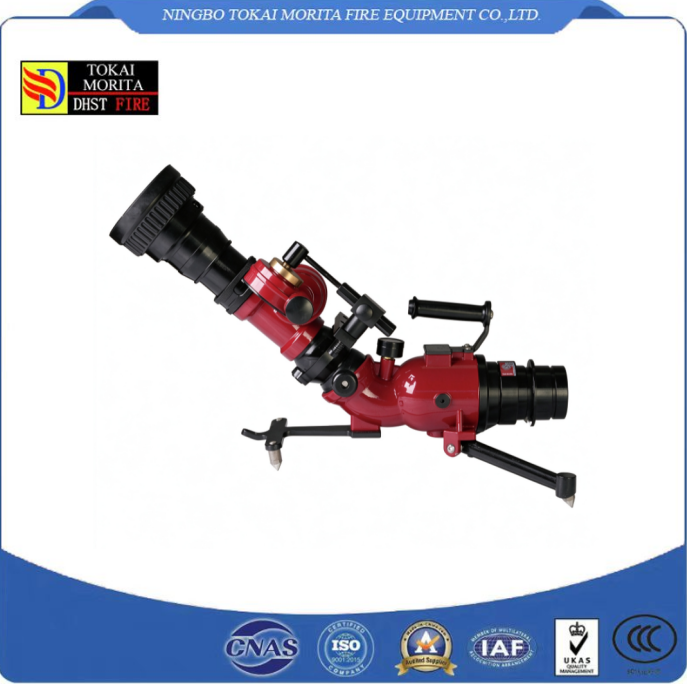
Assessing manual tiller-bar or handwheel controls highlights the value of mechanical simplicity and reliability. Manual units rely on direct physical input, offering immediate tactile feedback during operation. A tiller bar allows the operator to rapidly sweep the stream across a wide fire front, while handwheels provide precise, geared control for elevation and rotation. This mechanical directness ensures the monitor functions flawlessly regardless of battery charge levels, heavy radio interference, or extreme temperature drops that might otherwise compromise electronic systems during a prolonged winter operation.
Evaluating accessible controls means ensuring manual interfaces are oversized and easily operable. Personnel wearing bulky structural firefighting gloves lack fine finger dexterity. Handwheels must feature deep knurling or large spinner knobs that can be gripped securely. Elevation release pins and rotation locks must be operable with a closed fist or a simple palm strike. If an operator has to remove a glove to adjust the stream pattern, lock the elevation, or clear a jammed mechanism, the equipment design is fundamentally flawed for emergency response and introduces unnecessary burn risks to the firefighter.
Enabling true stand-off operations highlights the operational safety benefits of a remote controlled fire monitor in hazardous environments. Incidents involving chemical spills, structural collapse zones, or Boiling Liquid Expanding Vapor Explosion (BLEVE) risks require massive water application, but placing personnel within the blast radius is unacceptable. Remote units allow crews to establish the water supply, position the monitor, and retreat to a safe command post behind hard cover. From there, they can adjust the stream, sweep the hazard, and gate the flow without exposing human life to toxic plumes, shrapnel, or intense thermal radiation.
Range, frequency reliability, and redundancy are non-negotiable for remote-controlled units operating in heavy interference environments. Industrial plants feature dense steel structures, pipe racks, and high-voltage equipment that easily disrupt standard radio frequencies. Industrial-grade remote systems utilize frequency-hopping spread spectrum (FHSS) technology to maintain a solid, encrypted connection up to 300 meters away. Furthermore, every remote unit must feature accessible manual overrides. If the transmitter is dropped, crushed, or the battery fails, operators must be able to walk up to the unit and manually adjust the elevation and rotation using integrated handwheels.
Identifying primary use cases for automated sweeping patterns reveals the efficiency of a portable oscillating fire monitor. Cooling adjacent storage tanks, applying wide-area foam blankets over aviation fuel spills, or protecting structural exposures requires continuous, sweeping water application. Doing this manually ties up a firefighter who could otherwise be performing search and rescue, establishing secondary water supplies, or conducting interior attack. An oscillating monitor automates this task entirely, moving the nozzle back and forth continuously, effectively multiplying the workforce on the fireground and ensuring consistent cooling of the target hazard.
Comparing mechanical oscillation mechanisms against battery-powered units involves assessing maintenance realities and water supply conditions. Mechanical units use a water-driven turbine, known as a Pelton wheel, integrated directly into the waterway. As water flows, it spins the turbine, which drives a gearbox to sweep the monitor. This requires no electricity and is highly reliable in clean municipal water systems. However, drafting raw water from ponds or rivers introduces debris that can jam the turbine blades. Battery-powered oscillators bypass the waterway entirely, using a rugged electric motor to drive the rotation, making them immune to waterborne debris but reliant on strict battery management protocols.
Adjustable sweep angles and elevation limits are required for precise application. Operators must be able to set the oscillation width—often selectable between 20, 40, 60, or 80 degrees—to match the exact size of the exposure or fuel spill. If the sweep is too wide, water is wasted on unburned areas and runoff increases; if too narrow, the edges of the exposure may overheat and fail. Elevation limits ensure the stream does not drop too low and disrupt the fragile foam blanket or rise too high and overshoot the target tank, wasting valuable suppression agents.
Evaluating the viability of an electric fire monitor deployed in the field requires strict scrutiny of environmental protections. Firegrounds are inherently wet, dirty, and subject to extreme physical impacts. Any electric monitor must carry a minimum IP67 or IP68 waterproof rating, ensuring the internal circuit boards, drive motors, and battery housings can withstand total submersion in water without short-circuiting. Ruggedization of electronic components includes potting circuit boards in epoxy to prevent vibration damage during apparatus transit and utilizing marine-grade stainless steel for all exposed electrical connectors to prevent rapid oxidation.
Integration capabilities with apparatus power systems define the operational endurance of these units. The trade-off exists between tethered power and fully autonomous battery operation. Autonomous units utilize high-capacity lithium-ion battery packs, offering exceptional mobility without dragging heavy power cords through debris and broken glass. However, battery life is finite, often limited to a few hours of continuous movement. Tethered systems use a heavy-duty umbilical cord connected directly to the fire engine's 12V or 24V electrical system, providing unlimited operational time at the cost of restricted deployment distance and increased trip hazards on the fireground.
Determining which nozzle type best accommodates the variability of municipal or industrial water supplies requires comparing single-flow, selectable gallonage, and automatic monitor nozzles. Single-flow nozzles are mechanically simple, delivering a specific flow rate at a specific pressure. They excel in industrial settings with fixed, reliable pump capacities. Selectable gallonage nozzles allow the operator to manually rotate a baffle ring to adjust the flow rate, adapting to weaker municipal hydrants. Automatic nozzles feature an internal spring mechanism that constantly adjusts the baffle to maintain a consistent nozzle pressure and stream reach, regardless of fluctuations in the water supply.
Nozzle Type | Internal Mechanism | Best Operational Use Case | Primary Tactical Limitation |
|---|---|---|---|
Single-Flow | Fixed orifice size with no moving baffle parts. | Industrial facilities with dedicated, high-pressure fire pumps and known flow rates. | Cannot adapt to poor water supply; stream reach degrades severely if pressure drops. |
Selectable Gallonage | Manual rotating baffle ring to change orifice size. | Municipal departments facing variable hydrant pressures across different city zones. | Requires operator intervention and communication with the pump panel to match discharge pressure. |
Automatic | Internal pressure-regulating spring adjusts dynamically. | Transitional attacks where supply lines are being established, changed, or relayed. | Can mask low water flow by maintaining a good looking stream with dangerously low actual volume. |
The operational importance of slide valves for complete nozzle-man flow control cannot be ignored. Traditional ball valves create severe turbulence when partially closed, which shreds the water stream, introduces air pockets, and destroys reach and penetration. Slide valves, conversely, use a stainless steel cylinder that slides backward and forward over the waterway. This design allows operators to gate the water flow—reducing the volume—without disrupting the stream quality or pattern. This is critical when conserving water during overhaul operations or when transitioning from a straight stream to a wide fog pattern to protect crews from radiant heat.
Foam aspiration attachments and compatibility dictate the unit's effectiveness in industrial firefighting applications. When combating Class B flammable liquid fires, simply flowing water and foam concentrate is insufficient. The nozzle must aerate the mixture to create a thick, stable foam blanket that suppresses volatile vapors and seals against hot metal surfaces. Portable monitors must feature quick-attach aeration tubes that snap over the primary nozzle, instantly converting the unit from a standard water monitor to a high-expansion foam delivery system without requiring specialized tools or shutting down the water supply.
Material selection trade-offs define the lifespan and mobility of the equipment. Hard anodized aluminum alloys are the standard for municipal fire departments. This material provides lightweight mobility, allowing a single firefighter to deploy a 30-pound monitor rapidly across a yard or up a flight of stairs. The hard anodization process creates a ceramic-like surface that resists scratches and mild corrosion. However, in extreme industrial environments—such as petrochemical refineries, desalination plants, or offshore oil platforms—aluminum degrades rapidly due to galvanic corrosion and constant salt exposure. In these settings, heavy cast brass or 316L stainless steel monitors are required, trading mobility for decades of extreme corrosion resistance.
The tactical importance of a low attack angle dictates how effectively the monitor can penetrate structures. Many traditional monitors cannot lower their stream below 30 degrees without the reaction force lifting the front legs off the ground, causing the unit to flip backward. Advanced portable designs engineer the waterway to allow attack angles down to 10 or 20 degrees. This low trajectory is vital for shooting water straight through front doors, operating in confined spaces, and hitting the underside of industrial pipe racks where fires often hide. Furthermore, a lower attack angle directs the reaction force vector sharply downward, dramatically increasing ground stability and spike engagement.
Evaluating inlet types ensures strong, leak-free connections under high pressure. The choice between Storz, National Hose (NH) threaded, or British Standard Pipe (BSP) depends entirely on regional standards and existing department infrastructure. Storz connections are sexless, quarter-turn couplings that allow for incredibly fast connections in the dark or under stress, as there are no male or female ends to match. Threaded connections, while slower to attach, offer exceptional resistance to cross-threading and blow-offs under extreme pressure surges. Regardless of the fitting type, the monitor's inlet must feature a robust swivel mechanism to prevent the heavy, rigid supply hose from twisting and flipping the base during deployment.
The utility of dual-inlet clappered siamese configurations provides immense tactical flexibility for a portable firefighting water cannon. A single 2.5-inch hose often cannot supply enough water to maximize the monitor's flow capacity without exceeding safe pump discharge pressures. A dual-inlet base allows two supply lines to be connected simultaneously. Internal clapper valves act as check valves; if one line bursts, loses pressure, or needs to be disconnected to extend a line, the clapper slams shut, preventing water from flowing backward out of the open inlet. This allows pump operators to add or remove supply lines without ever shutting down the monitor, ensuring uninterrupted fire suppression.
The severe risk of improper base anchoring leads directly to equipment damage or personnel injury. A monitor flowing 1000 GPM that breaks loose acts like a massive, unguided missile, capable of breaking legs or causing fatal blunt force trauma. Strict training on ground surface evaluation is mandatory. Firefighters must be trained to recognize that concrete, asphalt, soil, and ice require entirely different anchoring techniques. Deploying on concrete without a safety strap is a critical failure. Deploying on soil without fully extending and locking the carbide spikes will result in the unit digging a trench and flipping backward. Hands-on drills must simulate these different surfaces under flowing water conditions.
Developing Standard Operating Guidelines (SOGs) for the safe transition from handlines to portable monitors establishes fireground discipline. Crews must know exactly when to call for a portable monitor and when to abandon interior attacks. The SOG should dictate the communication protocols between the nozzle operator and the pump panel engineer. Because portable monitors require high pump discharge pressures to overcome friction loss in the supply hose, the engineer must throttle up the engine slowly to prevent water hammer from blowing hose couplings or damaging the monitor's internal valves. The SOG must also outline the exact sequence for shutting down the monitor and bleeding the hose line before crews cross the threshold for interior attack.
Debris management and flushing procedures dictate the longevity of internal valves and oscillation turbines. During major incidents, fire engines often draft raw water from lakes, rivers, or portable drop tanks. This water contains silt, rocks, and biological debris. If this debris enters the monitor, it can score the slide valve seals, causing permanent leaks, or jam the Pelton wheel in an oscillating unit, rendering the automatic sweep useless. Post-incident maintenance must include a mandatory clean-water flush. Operators should open the nozzle to its widest flush setting and flow clean municipal water through the unit for several minutes to clear all internal waterways and dislodge trapped stones.
Routine maintenance schedules prevent catastrophic failures on the fireground. Lubrication of all swivel joints, elevation gears, and locking pins using specialized, non-water-soluble marine grease is required bi-annually to prevent seizing. Carbide spikes must be inspected after every use; if the tips are rounded, chipped, or missing, they can no longer grip asphalt and must be replaced immediately. For electric and remote units, battery management is critical. Lithium-ion batteries must be kept on smart chargers inside the climate-controlled apparatus cab to prevent deep discharge and protect them from freezing temperatures during winter operations, ensuring they are at 100 percent capacity when the tones drop.
Criteria for evaluating a fire monitor supplier extend far beyond the initial purchase price. A high-quality monitor is a multi-decade investment that your personnel will rely on in life-or-death situations. Departments must assess the supplier's technical support infrastructure. When a unit requires a rebuild after five years of heavy use, the availability of domestic spare parts is crucial. Waiting six months for an overseas shipment of O-rings, replacement circuit boards, or turbine gears renders the equipment useless. Buyers should demand proof of localized parts warehousing and authorized service centers within their region before signing a purchase order.
Ensuring strict compliance with NFPA 1964 (Standard for Spray Nozzles and Appliances) or equivalent international standards guarantees performance and safety. A reputable supplier will provide certified third-party testing documentation upon request. This includes hydrostatic testing to ensure the cast aluminum body will not rupture under extreme pressure surges, salt-spray testing to verify corrosion resistance over time, and rough-handling drop tests to prove the unit can survive falling off the back of a moving fire engine. Purchasing non-certified equipment introduces unacceptable liability to the fire department and endangers the lives of the operating crew.
The optimal portable fire monitor is not simply the one with the highest flow rate, but the unit that best aligns with a department's specific staffing levels, typical hazard profiles, and apparatus storage constraints. A massive 2000 GPM monitor is useless if a three-person engine company cannot physically deploy it in under two minutes. Conversely, a lightweight quick-attack monitor will fail to protect exposures at a massive industrial refinery fire. Prioritize base stability, manageable weight, and reliable flow control first. A monitor that cannot hold its ground safely is a liability, regardless of its technological features. Evaluate advanced features like mechanical oscillation or remote control only after establishing the baseline requirements for your highest-risk scenarios.
Request field demonstrations from multiple manufacturers to test deployment speed and ergonomics on various surfaces, including wet asphalt, concrete, and loose soil.
Review hydraulic calculations and friction loss data with your pump operators to ensure your current hose inventory can adequately supply the chosen monitor at the required pressure.
Conduct hands-on deployment drills with full structural turnout gear and bulky gloves to verify that all manual controls, locks, and valves are easily operable under stress.
Audit the warranty terms, third-party testing certificates, and spare parts inventory of your chosen supplier to guarantee long-term operational readiness.
A: Most portable ground monitors are engineered to safely flow between 500 and 1000 GPM (1900 to 3800 l/min). Exceeding the manufacturer's maximum rated flow generates excessive reaction force, which can overpower the base stability mechanisms, causing the unit to slide, lift, or break traction, creating a severe hazard for operators.
A: Mechanical oscillating monitors utilize a water-driven turbine, often called a Pelton wheel, located inside the waterway. As pressurized water flows through the monitor, it spins the turbine. This rotational energy drives a sealed gearbox that moves the nozzle back and forth in a continuous sweeping pattern.
A: Yes. Modern quick attack monitors are constructed from lightweight hard-anodized aluminum, often weighing under 35 pounds. A single firefighter can carry the unit, deploy the folding legs, connect the supply line, and initiate water flow without assistance, making them ideal for understaffed engine companies.
A: Stability relies on carbide-tipped ground spikes that dig into the surface, a low center of gravity, and wide folding legs. Additionally, integrated safety valves automatically reduce the water flow by up to 90% if the unit loses ground contact or begins to slide, eliminating the dangerous reaction force.
A: Remote controlled monitors are necessary when operating in highly hazardous environments where human exposure is unacceptable. This includes chemical spills, structural collapse zones, unexploded ordnance incidents, or fires involving pressurized tanks with a high risk of Boiling Liquid Expanding Vapor Explosions (BLEVE).
A: Automatic nozzles feature an internal pressure-regulating spring that constantly adjusts the baffle opening to maintain a consistent stream reach and pressure, even if the water supply fluctuates. Selectable nozzles require the operator to manually rotate a ring to choose a specific flow rate to match the pump discharge.
A: Look for strict compliance with NFPA 1964 or equivalent standards. Evaluate their post-sale support by verifying domestic spare parts availability, warranty length, and the presence of authorized service centers. A reliable supplier should also provide comprehensive hydraulic flow charts and friction loss data for their equipment.


