
Views: 0 Author: Site Editor Publish Time: 2026-09-23 Origin: Site
Drafting water during fireground operations presents immediate mechanical risks. Drawing from open ponds, static tanks, or compromised municipal lines introduces heavy debris into the intake. Centrifugal fire pumps and downstream hydraulic systems remain highly vulnerable to these environmental hazards. Even minor debris like rocks, aquatic life, loose weld metal, pipe scale, and rust cause catastrophic impeller damage. They block internal cooling lines, clog downstream sprinklers, and induce sudden pump failure during active fire attack. The fire suction strainer acts as your primary line of defense. It serves as a mandatory pre-filtration mechanism for any drafting setup. This technical guide breaks down strainer mechanics, flow rate calculations, and material construction. You will learn how to evaluate specifications and select the right equipment to ensure continuous pump operation under extreme field conditions.
Impeller and System Protection: A properly specified fire pump suction strainer prevents catastrophic mechanical failure by blocking large particulates and impurities without starving the pump of water.
Downstream Safeguarding: Effective pre-filtration at the suction inlet ensures that debris does not bypass the pump to clog delicate downstream fire protection systems, such as fog nozzles, hydrants, and sprinkler heads.
Flow Rate vs. Filtration Trade-off: Selecting the correct open area ratio is critical to balancing adequate pre-filtration with the Net Positive Suction Head (NPSH) required to prevent cavitation.
Coupling and Hose Compatibility: Seamless integration with existing fire suction hose infrastructure—including specific regional standards like the French coupling suction strainer—is mandatory for rapid deployment.
Supplier Reliability: Sourcing from a vetted firefighting equipment supplier ensures adherence to NFPA standards, material traceability, and reliable performance under extreme pressure.
The intake phase represents the most vulnerable stage of water delivery. Atmospheric pressure pushes water up the hard suction hose only when the pump primer creates a sufficient vacuum. You place the strainer at the absolute lowest point of this drafting setup, submerged in the water source. Sometimes, mechanics mount a secondary screen directly ahead of the pump intake manifold. Its primary function remains straightforward yet highly technical. It acts as the initial pre-filtration stage. The device traps and removes solid impurities before water ever enters the hydraulic system. Without this physical barrier, the pump ingests raw, unfiltered water. This exposes internal bronze and stainless steel components to immediate kinetic threats. The strainer dictates the quality and volume of the water supply entering the apparatus.
Centrifugal fire pumps operate at extremely high speeds, with impellers spinning at thousands of revolutions per minute. The clearances between the impeller vanes and the wear rings are exceptionally tight, often measuring just thousandths of an inch. High-velocity debris striking a spinning centrifugal impeller causes severe kinetic damage. A small rock or a one-inch piece of slag acts like a projectile inside the pump casing. It chips the impeller vanes, degrades the cutwater, and gouges the volute. The fire pump suction strainer acts as a physical barrier against these environmental projectiles. It also blocks industrial contaminants like loose weld metal, rust, and scale commonly found in static water tanks. Preventing this debris ingestion stops mechanical imbalance. Imbalance quickly leads to destroyed pump seals, catastrophic bearing failure, and massive overhaul costs.
Pump cavitation destroys metal faster than abrasive wear. A properly designed strainer maintains laminar flow into the intake manifold. Restricted intake starves the pump of necessary water volume. When you starve a pump, localized pressure drops occur inside the eye of the impeller. If this pressure falls below the vapor pressure of water at the ambient temperature, the liquid literally boils. Destructive cavitation bubbles form and then collapse violently against the metal surfaces as they move into higher-pressure zones. This implosion creates microscopic shockwaves that pit and erode the impeller. Engineered strainers prevent these severe pressure drops. They ensure the pump receives adequate volume to maintain a safe Net Positive Suction Head (NPSH), keeping the available pressure higher than the required pressure.
The suction strainer serves a vital dual purpose. It protects the pump itself, but its job extends far beyond the apparatus. It prevents fine particulates from traveling through the discharge manifold. Debris that bypasses the pump enters the downstream infrastructure. This clogs automated sprinkler systems, standpipes, and handline nozzles. Modern fog nozzles feature spinning teeth and very small internal orifices. A blocked fog nozzle on an interior fire attack line endangers personnel immediately, causing a sudden loss of water stream reach and thermal protection. Clogged sprinkler heads in a commercial building allow fires to spread unchecked. Effective pre-filtration at the drafting source ensures the entire hydraulic chain remains clear and fully operational.
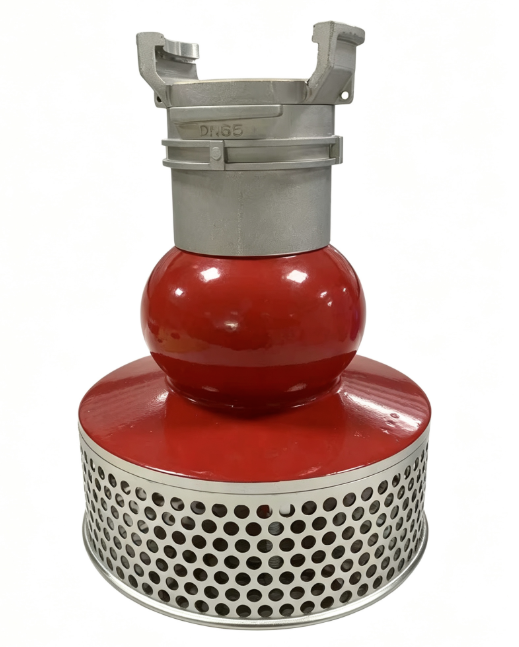
Standard barrel and basket strainers represent the baseline for deep-water drafting. Crews use them heavily in permanent static tank installations, drafting pits, and deep municipal cisterns. Their cylindrical shape offers excellent flow dynamics. They provide a massive surface area advantage compared to flat screens. This large surface area makes them highly effective at filtering out heavy tank scale and rust without restricting flow. When submerged in deep water, they pull water from all 360 degrees. This multidirectional intake reduces the likelihood of a total blockage from a single piece of debris. They remain the standard choice for municipal pumpers drafting from clean, deep sources where bottom mud is not a concern.
Drafting from shallow open water sources requires specialized equipment. Ponds, creeks, and flooded areas present unique environmental challenges. Floating suction strainers solve these specific problems. Their design incorporates a buoyant chamber that keeps the intake screen suspended below the water surface but well above the floor. This mechanical positioning prevents the ingestion of bottom mud, silt, and rocks. Simultaneously, the float blocks surface debris like leaves, algae, and plastic waste. The pump draws clean water from the middle column. This maximizes drafting efficiency in less-than-ideal rural or wildland firefighting scenarios where deep water is unavailable.
Portable drop tanks demand a completely different approach to water extraction. Low-level strainers excel in these specific rural water shuttle operations. Maximizing usable water volume from a folding tank is critical during relay pumping. These strainers sit flat against the bottom of the tank. They allow pumps to draft water down to a depth of just one or two inches without sucking air. They incorporate engineered anti-vortex designs. These internal baffles break the rotational flow of water, preventing whirlpools from forming at the intake. Whirlpools introduce air into the suction line, which causes the pump to lose its prime immediately. Low-level models prevent this operational failure.
Deploying a low-level strainer during a water shuttle operation requires specific steps to ensure maximum efficiency:
Unfold the portable drop tank on level ground to ensure uniform water depth.
Connect the low-level strainer to the hard suction hose using a heavy-duty spanner wrench to guarantee an airtight seal.
Position the strainer flat on the floor of the tank, ensuring the anti-vortex plate is parallel to the water surface.
Tie off the strainer and hose with a utility rope to the tank frame to prevent shifting during high-flow drafting.
Monitor the water level continuously, signaling water tenders to dump before the level drops below the two-inch threshold.
Manufacturing materials dictate the lifespan, maintenance schedule, and deployment speed of your equipment. Hardcoat anodized aluminum offers exceptional weight savings. This makes it ideal for rapid manual deployment by single operators during fast-moving wildland incidents. However, it requires careful maintenance to prevent galvanic corrosion when connected to brass fittings. Brass provides superior corrosion resistance. It excels in permanent marine environments or industrial settings where saltwater is prevalent. Stainless steel delivers the ultimate durability against heavy impacts and scale. You must evaluate the trade-offs between weight and longevity based on your specific operational environment.
Material Type | Weight Profile | Corrosion Resistance | Primary Application Scenario |
|---|---|---|---|
Hardcoat Anodized Aluminum | Lightweight (Easy manual handling) | Moderate (Susceptible to galvanic action if mixed with brass) | Mobile apparatus, rapid deployment, portable drop tanks. |
Cast Brass / Bronze | Heavy (Requires multiple personnel for large diameters) | Excellent (Highly resistant to saltwater and marine growth) | Marine drafting, permanent coastal installations, fireboats. |
Stainless Steel | Moderate to Heavy | Superior (Resists rust, scale, and industrial chemicals) | Industrial static tanks, harsh chemical environments, refineries. |
Selecting the correct perforation size requires a strict mathematical framework. The mesh must block harmful debris without restricting water flow. The relationship between the strainer's total open area and the hose cross-section is critical. Industry standards dictate maintaining an Open Area Ratio (OAR) of at least 3:1 to 4:1. This means the total area of all holes combined must be three to four times larger than the hose opening. For example, a 6-inch hose has a cross-sectional area of roughly 28.27 square inches. A 4:1 OAR requires the strainer to have at least 113 square inches of open hole space. This ratio minimizes friction loss across the device. It maximizes impurity removal while ensuring the pump receives its required volume to meet its rated capacity.
Matching strainer connections to your existing fleet hardware prevents deployment delays. Incompatible threads render fire hose suction equipment completely useless on the fireground. You must evaluate specific connection standards based on your region and apparatus specifications. Standard NH/NST threads dominate North American municipal fleets, requiring threaded connections and gaskets. Storz connections offer rapid quarter-turn coupling for large diameter hoses, speeding up deployment times. Regional standards also dictate procurement. Integrating a French coupling suction strainer requires exact matching with symmetrical Guillemin or DSP fittings. Verify thread pitch, gasket condition, and locking mechanisms before finalizing any equipment purchase.
Fireground equipment must meet strict regulatory standards to ensure safety and reliability under extreme pressure. Verifying NFPA compliance is an absolute necessity for municipal and industrial fire departments. NFPA 1901 and NFPA 1911 outline specific performance standards for apparatus equipment and drafting operations. Strainers must pass rigorous flow tests to meet these benchmarks, proving they can support the pump at 100% of its rated capacity at a 10-foot lift. Additionally, check for UL listing or FM approval where applicable, especially for permanent industrial installations. These certifications guarantee the equipment withstands rated pressures and vacuum forces. They provide legal and operational peace of mind for fire chiefs and facility managers.
Strainers face the operational reality of becoming blinded by debris over time. Leaves, plastic bags, and heavy rust accumulate on the exterior mesh during long-duration drafting. This gradual blockage chokes the water supply. It forces the pump to work harder, increasing vacuum pressure to dangerous levels and risking cavitation.
Establish strict protocols for continuous monitoring of intake compound pressure gauges.
Assign personnel to visually inspect floating or shallow water strainers during long operational periods.
Deploy secondary or cleanable basket strainers in relay pumping setups to catch debris that bypasses the primary screen.
Keep a backup strainer on standby for immediate swap-out if heavy blinding occurs in dirty water sources.
Undersizing the strainer relative to the pump's rated capacity creates immediate hydraulic failures. A strainer that is too small restricts flow and increases friction loss. This lowers the pressure at the pump inlet, leading directly to vaporization and cavitation damage. The pump will fail to reach its rated capacity, jeopardizing fire attack operations.
Cross-reference your pump performance curves with the strainer's friction loss data provided by the manufacturer.
Calculate the required Net Positive Suction Head (NPSH) for your maximum drafting flow rate.
Ensure the strainer's Open Area Ratio exceeds the minimum 3:1 requirement for the attached fire suction hose.
Consult hydraulic calculation tables before finalizing the equipment size for high-capacity industrial pumpers.
A poorly seated strainer introduces air into the suction line. Damaged gaskets, dirt on the coupling face, or mismatched threads compromise the vacuum seal. When air enters the intake, the pump immediately loses its prime. Drafting operations halt entirely until crews locate and fix the leak, stopping water flow to the fireground.
Enforce strict maintenance schedules for all suction hose gaskets and coupling faces, replacing dry-rotted rubber immediately.
Use only high-quality, compatible couplings that match your fleet's exact thread specifications.
Conduct regular dry vacuum tests on all drafting equipment to identify micro-leaks before they cause failures on the fireground.
Train personnel on proper coupling techniques using appropriate spanner wrenches to ensure a tight, airtight seal.
Evaluating a supplier requires looking beyond their product catalog. You need a partner with deep technical expertise in fluid dynamics and pump operations. Do they offer hydraulic calculation support? Can they explain NPSH requirements for your specific pump model? A mere catalog distributor cannot help you troubleshoot complex drafting issues. Look for a firefighting equipment supplier that understands friction loss, cavitation physics, and pump performance curves. Their engineering knowledge directly impacts the safety and efficiency of your fireground operations.
Fire departments cannot afford long wait times for critical components. Rapid availability of replacement parts dictates apparatus readiness. You need a supplier that stocks specific coupling adapters, gaskets, and heavy-duty drafting equipment. Assess their warehouse capacity and shipping logistics. When a strainer gets crushed by a backing apparatus on the fireground, you need a replacement immediately. Reliable suppliers maintain deep inventory levels of standard and specialized equipment. They ensure your apparatus returns to service without unnecessary delays.
Quality assurance separates reliable manufacturers from budget alternatives. You must demand suppliers who provide verifiable material test reports. Request flow test data to confirm the strainer meets its advertised friction loss metrics under actual drafting conditions. A robust warranty against manufacturing defects is non-negotiable. Documentation proves the equipment complies with NFPA standards. It ensures material traceability for liability purposes. Insist on comprehensive paperwork for every piece of critical hydraulic equipment you purchase.
Audit your current suction equipment inventory for damaged mesh, missing anti-vortex baffles, or worn gaskets.
Cross-reference your pump's performance curves with the friction loss data of your current strainers to verify flow compliance.
Standardize your coupling threads across all apparatus to prevent deployment delays during mutual aid responses.
Execute a dry vacuum test on all hard suction hoses and strainers to identify micro-leaks before field deployment.
A: It serves as a critical pre-filtration device during drafting operations. It filters out large debris, loose weld metal, rocks, and impurities from the water source. This protects the pump impeller from mechanical damage, safeguards downstream sprinklers and hydrants from clogging, and helps maintain consistent system pressure.
A: You must match the strainer's connection size to your fire suction hose diameter. More importantly, ensure the strainer has a high Open Area Ratio (typically 3:1 or greater). This means the total area of the strainer holes is much larger than the hose opening, preventing flow restriction.
A: Yes. When debris clogs the strainer, it severely restricts water flow. This restricted flow lowers the pressure at the pump inlet. If the pressure drops below the water's vapor pressure, the water boils, creating cavitation bubbles that collapse and destroy internal pump components.
A: Yes. While its primary job is protecting the pump impeller, it also prevents fine debris from entering the entire hydraulic system. This keeps downstream fire protection systems, such as handline nozzles, automated sprinkler heads, and standpipes, from becoming clogged during operation.
A: It is a specialized strainer designed to connect with French standard symmetrical fittings, such as Guillemin or DSP couplings. It is used primarily in regions or facilities that have standardized on these specific locking mechanisms, ensuring a seamless and airtight connection with compatible hoses.
A: You should inspect suction equipment immediately after every use. Look for crushed mesh, damaged threads, or missing gaskets. Additionally, conduct routine checks aligned with NFPA standards during regular apparatus maintenance schedules to ensure the equipment is ready for deployment.
A: A standard strainer is designed for deep water or clean static tanks, offering maximum surface area for heavy particulate filtration. A floating strainer is engineered for shallow open water. It floats just below the surface to avoid drawing in bottom mud and silt while blocking floating surface debris.


