
Views: 0 Author: Site Editor Publish Time: 2026-11-17 Origin: Site
High-hazard industrial environments and complex municipal fire scenarios require suppression systems that remove personnel from immediate blast, heat, or toxic exposure zones without compromising stream accuracy or volume. Transitioning from manual suppression to automated or remote systems introduces variables in power reliability, control latency, and integration with existing hydraulic infrastructure. Facility managers and fire engineers must balance the motor-driven articulation capabilities against the operational necessity of remote deployment. This guide provides a framework for evaluating an Electric Fire Monitor, analyzing technical specifications, comparing fixed versus portable configurations, and establishing criteria for selecting a reliable manufacturing partner.
Safety Through Distance: Electric fire monitors enable operators to direct high-volume water or foam streams from safe, remote control rooms, drastically reducing personnel risk in volatile environments.
Application-Specific Configurations: Selecting between fixed installations and a Portable Fire Water Cannon depends on the facility's hazard mobility, existing pipe infrastructure, and tactical response protocols.
Integration Complexity: Successful deployment requires rigorous assessment of control cabinet placement, power redundancy, and signal latency between the remote console and the monitor's electric actuators.
Supplier Vetting is Critical: Partnering with a certified OEM Fire Monitor Supplier ensures access to explosion-proof components, custom flow calibrations, and long-term maintenance support.
Establishing success criteria for remote suppression involves calculating baseline requirements for flow rates, effective reach, and latency from detection to activation. Engineers must identify environments where manual intervention is restricted, such as petrochemical refineries, offshore oil platforms, aircraft hangars, or hazardous waste processing facilities. Your assessment should determine if the primary objective is direct source suppression—applying agents onto the fire—or exposure protection, where the monitor creates a water curtain to shield assets from radiant heat.
When comparing a manual unit to a Remote Controlled Fire Monitor, consider the mechanical simplicity of manual gear versus the operational precision of robotic systems. While manual monitors cost less upfront, they demand a human presence in the potential hot zone. Robotic, remote-operated systems remove personnel from risk but introduce electrical dependencies that necessitate robust fail-safes and secondary power sources. To determine if your facility is ready for an electric upgrade, conduct a thorough survey of your existing hydraulic mains to ensure they can sustain the backpressure generated by continuous automated operation.
Flow dynamics are the foundation of any suppression system. Evaluating the correlation between inlet pressure and effective stream reach determines whether your chosen unit will hit its target under wind or heat conditions. Precision is paramount; the electric motors must maintain consistent elevation and horizontal rotation even when subjected to the high-reaction forces of a full-volume discharge. You should request flow-versus-pressure charts for every unit under consideration to guarantee the equipment meets your site-specific trajectory requirements.
Durability metrics ensure the equipment survives the very events it is meant to control. Always verify the Ingress Protection (IP) rating, with IP65 or higher being the standard for water and dust resistance in harsh industrial climates. In volatile atmospheres, you must confirm that motors and junction boxes carry appropriate explosion-proof certifications. Material choices also dictate longevity; while hard-anodized aluminum offers a lightweight profile, stainless steel 316L is typically preferred for highly corrosive environments or saline-heavy coastal installations.
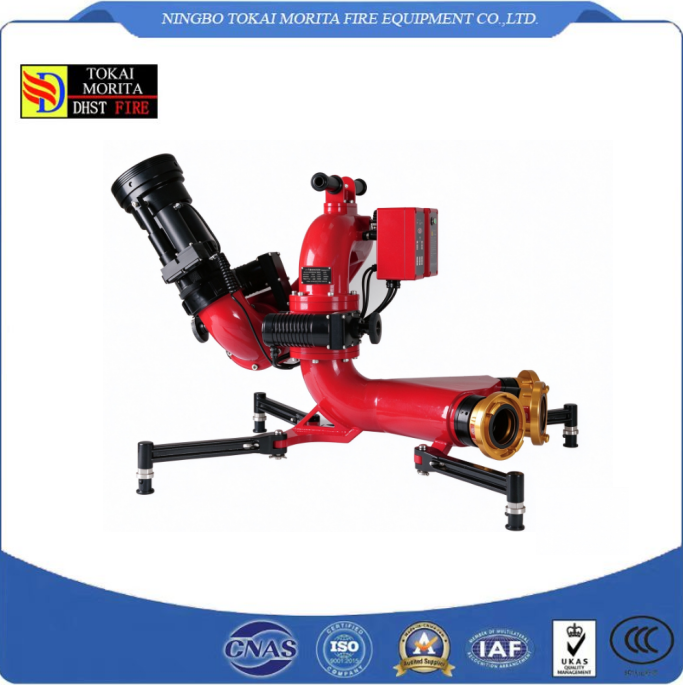
The following table outlines the key technical components you must review before finalizing your procurement list:
Component | Technical Consideration | Why It Matters |
|---|---|---|
Motor Torque | Holding force against water pressure | Prevents "drift" during high-flow discharge |
IP Rating | IP65 vs IP67 verification | Ensures longevity in outdoor wet environments |
Control Latency | Milliseconds of response delay | Critical for targeting moving or flash-fire risks |
Material Grade | Hard anodized vs 316L Stainless | Dictates resistance to chemical/salt corrosion |
Fixed installations offer permanent protection for high-value assets like fuel storage tanks or loading docks. These systems often interface directly with facility-wide fire alarms for automated response, reducing the "time-to-first-drop" significantly compared to human-activated monitors. However, many facilities require the tactical flexibility of a Portable Fire Water Cannon. When selecting portable units, evaluate the weight-to-flow ratio and the effectiveness of stability mechanisms like ground spikes or heavy-duty safety straps. Operators must receive specific training on managing reaction thrust, as portable systems can become unstable if not secured correctly during emergency activation.
The Portable Oscillating Fire Monitor fills the gap between fixed and manual options by automating wide-area coverage. These units can sweep back and forth automatically, providing continuous cooling across a zone without requiring an operator's constant attention. Look for adjustable sweep angles and speed settings that allow you to tune the oscillation to the specific size of the hazard. A robust oscillator reduces the risk of thermal runaway by ensuring that water coverage remains constant even if the site team is busy managing other tactical aspects of the response.
Control infrastructure creates the most common points of failure in remote systems. A significant risk is latency, or the delay between joystick input and actual movement. To mitigate this, prioritize hardwired connections like RS485 or Ethernet over wireless systems unless the application strictly demands RF flexibility. When designing your wiring layout, account for the potential for cable degradation in extreme heat, opting for armored conduit where necessary to maintain signal integrity during a fire event.
The physical placement of your control cabinet is equally vital. Guidelines dictate that control cabinets must remain in indoor, weather-protected, or non-hazardous zones. Cabinets must be positioned so that they are accessible to operators during an emergency, safely distanced from the fire’s direct heat or blast path. Always account for voltage drops in long cable runs, as these can affect motor performance. Implementing an uninterruptible power supply (UPS) for your monitor control system ensures that even if main facility power is lost during a fire, the fire suppression system remains operational.
Map all cable runs to minimize interference from high-voltage lines.
Install redundant power supplies at the control cabinet level.
Conduct stress tests on control actuators before final commissioning.
Ensure clear line-of-sight or sensor feedback loop verification during setup.
Partnering with an OEM Fire Monitor Supplier is a long-term commitment. You must verify their manufacturing capabilities, specifically their ability to machine waterways that minimize friction loss. Ask for technical submittals that demonstrate in-house testing for pressure, flow, and extreme environmental conditions. A high-quality supplier should provide custom engineering support, such as adapting flange sizes or control protocols to match your legacy infrastructure.
Compliance is non-negotiable. Ensure that your chosen equipment meets relevant international standards such as UL, FM, CE, or regional equivalents. Before finalizing a partnership, review the warranty terms and verify the long-term availability of replacement parts. A supplier that stocks critical components like sensors, nozzles, and replacement motors locally or with rapid shipping capacity will minimize your downtime during maintenance cycles. Ask for references from similar industrial sites to confirm the equipment holds up under the specific conditions of your operation.
An Electric Fire Monitor is a strategic investment in safety that prioritizes both personnel protection and suppression precision. By transitioning from manual to remote control, you effectively decouple the operator from the hazard. To ensure a successful implementation, follow these steps:
Conduct a comprehensive site hazard analysis to determine the precise trajectory and flow requirements for your specific environment.
Consult with fire protection engineers to plan the integration of the control system with existing fire detection infrastructure.
Request detailed technical compliance documentation and field test results from a vetted OEM Fire Monitor Supplier before procurement.
Establish a recurring maintenance schedule for motor seal inspection and gear drive lubrication to ensure system readiness.
A: A remote controlled monitor protects personnel by allowing operators to direct high-pressure water or foam from a safe distance. This keeps responders clear of extreme heat, toxic smoke, and explosion risks while maintaining precise aim through automated controls.
A: It uses either the kinetic energy of the water flowing through it or an integrated electric motor to automatically sweep the nozzle back and forth. This creates a continuous, unmanned cooling effect or a protective barrier across a wide area.
A: Requirements depend on the specific unit, but common industrial standards include 24V DC for mobile systems and 110V, 220V, or 380V AC for heavy-duty fixed installations. Using redundant power supplies is strongly recommended for safety-critical operations.
A: Yes. Modern units frequently interface with Fire Alarm Control Panels (FACP) using industrial protocols such as RS485 or Ethernet. This allows the system to automatically aim and discharge based on data from flame or heat detectors.
A: Look for verifiable international certifications, in-house hydraulic testing, and the ability to customize mechanical interfaces. A reliable supplier should provide long-term access to spare parts and engineering support for your facility’s specific integration needs.
A: Cabinets should be in a safe, non-hazardous, and weather-protected area. They must remain accessible to operators even during an active fire event, while being shielded from direct heat and blast zones to ensure continuous functionality.


