
Views: 0 Author: Site Editor Publish Time: 2026-10-09 Origin: Site
The pump roars. The hallway is superheated to near flashover conditions. At this exact moment, the hardware at the end of your hose line dictates whether you achieve a successful knockdown or face a catastrophic loss. A fire hose nozzle is not just a terminal exit for water. It is a precision fluid dynamics tool engineered to control the shape, velocity, reach, and volume of your suppression agent in a fully involved hazardous atmosphere.
Procurement officers and fire department administrators frequently face an overwhelming market. Countless variations exist. You will find traditional smooth bore setups, versatile combination models, and advanced automatic designs. Selecting the appropriate hardware is a high-stakes engineering decision. An incorrect choice results in inadequate heat absorption. It can cause dangerous physical pushback. Worse, it can rapidly deplete finite water supplies on the fire ground.
This comprehensive guide breaks down the objective criteria required to choose the optimal suppression tool. We will evaluate flow rates, pressure ratings, and specific tactical applications. Emergency response teams can use these engineering benchmarks to make evidence-based decisions that significantly enhance both operational efficiency and firefighter safety.
Identify Your Primary Application: Structural, wildland, and industrial firefighting environments each demand distinct architectures to maximize suppression efficiency.
Understand Hardware Types: Smooth bore configurations offer maximum reach and debris penetration. Combination and fog designs provide tactical versatility and superior ambient heat absorption.
Match Flow Rates to Tactics: The decision between fixed, selectable, and automatic flow rates must seamlessly align with a department's standard operating procedures and available water supply.
Manage Nozzle Reaction: Balancing the necessity for high flow rates with a manageable operating pressure is crucial. This reduces operator fatigue and prevents musculoskeletal injuries.
At its most fundamental level, this equipment is a specialized mechanical device attached to the coupling of a hose line. Its primary objective is to manipulate the extinguishing agent to achieve maximum knockdown power. This applies whether you are flowing municipal water or specialized chemical foam.
How do you evaluate this equipment effectively? You must master its three core operational functions. First, it controls the flow rate. It regulates the exact volume of water exiting the hose. Matching this Gallons Per Minute metric to the fire heat release rate is the foundational physics behind all successful fire suppression. Second, the device creates reach and penetration. By restricting the water pathway, it accelerates the stream. This ensures the water can safely bridge the stand-off distance to strike the seat of the fire. Finally, it shapes the stream. Internal baffles and external spinning teeth modify the water into a concentrated solid column or a dispersed fog. This allows the operator to adapt dynamically to shifting thermal conditions.
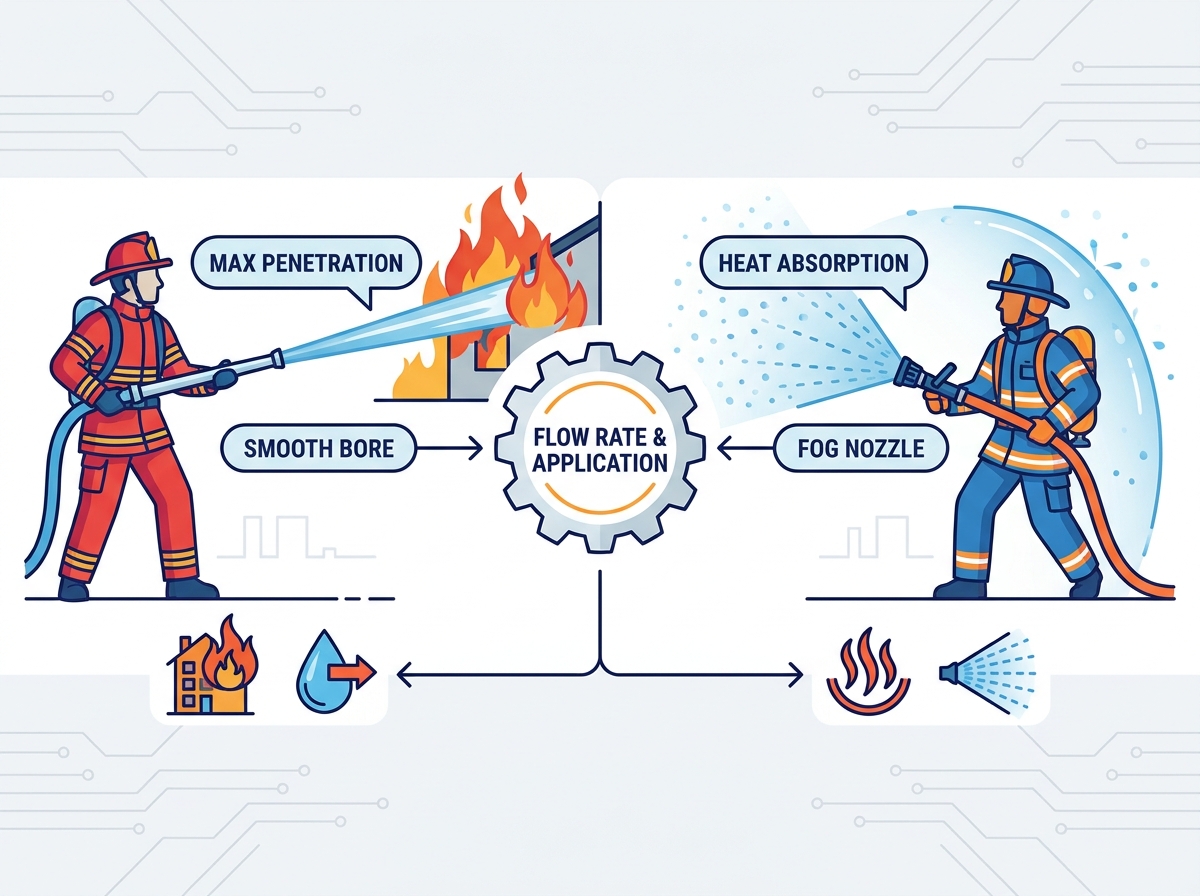
The foundational decision in procuring new equipment involves selecting the primary stream type. Different internal geometries yield vastly different suppression characteristics. This single choice directly impacts every tactical move made by your engine company.
Characterized by a simple and unobstructed cylindrical design, smooth bore models deliver a solid and heavy column of water. They typically operate at lower pump pressures. This is commonly around 50 PSI for standard handlines. From a tactical standpoint, they provide exceptional reach. They punch deep through compacted debris. Furthermore, the unobstructed waterway makes them highly resistant to clogging. Because they operate at lower pressures, they produce a highly manageable reaction force. This makes the charged hose line significantly easier for a single firefighter to advance. However, they cannot generate a fog pattern. This limitation reduces their ability to rapidly absorb ambient room heat.
In contrast, combination models are highly versatile tools. They allow the operator to transition seamlessly between a straight stream and various degrees of protective fog patterns. The finely atomized droplets created by the fog setting offer a massive surface area. This guarantees rapid heat absorption and steam conversion. Such characteristics make them ideal for aggressive interior gas cooling and hydraulic ventilation. The trade-off is that traditional models generally require higher operating pressures. This inherently increases physical strain on the crew.
Equipment Type | Primary Tactical Use | Standard Operating Pressure | Key Engineering Advantage |
|---|---|---|---|
Smooth Bore | Deep penetration, exterior attack | 50 PSI | Low fatigue, highly clog-resistant |
Selectable Combination | Interior attack, gas cooling | 75 - 100 PSI | Dynamic flow control, versatile patterns |
Automatic Fog | Variable water supply scenarios | 75 - 100 PSI | Maintains constant stream reach automatically |
Gallons Per Minute is the absolute lifeblood of fire suppression. If the volume of water applied does not exceed the thermal energy being generated, the fire will continue to grow. Understanding how different engineering technologies manage flow is paramount for procurement.
These devices are engineered to deliver a specific and constant flow rate at a designated pressure rating. They are heavily favored by departments that prioritize simplicity. They guarantee a known water volume. By removing the ability to adjust the flow, they eliminate the risk of an operator accidentally restricting water delivery during a high-stress and zero-visibility interior attack.
Selectable models feature a rotating external bezel. This mechanism allows the operator to manually choose the flow rate. For example, a premium selectable gallonage fire nozzle often allows switching between 115, 230, 360, and 480 Liters Per Minute. This adaptability proves highly valuable. It shines when transitioning from a defensive exterior posture to an aggressive interior push. It is equally critical when municipal water supply is suddenly constrained.
Automatic designs utilize an internal spring-loaded baffle mechanism. As the incoming pump pressure fluctuates, the spring continuously adjusts the baffle position. This maintains a near-constant operating pressure and stream reach. Consequently, even if the engine water volume drops unexpectedly, the stream will not immediately lose its structural integrity. This engineering safeguard keeps the crew protected under dynamic conditions.
The physics of nozzle reaction is a critical safety and ergonomic consideration. This is the backward thrust exerted on the operator. Higher operating pressure directly correlates to higher pushback. This accelerates fatigue and drastically increases the likelihood of slip-and-fall injuries on the fire ground.
Recent market data reveals a definitive industry shift. Fire suppression tactics are moving rapidly toward low-pressure and high-volume delivery systems. Modern structural fires burn significantly hotter and faster today. This is due to the massive prevalence of polyurethane foams and synthetic building materials. To combat these extreme heat release rates, departments are abandoning legacy high-pressure equipment. Current engineering trends show a massive surge in the adoption of low-pressure models operating at 50 to 75 PSI. These systems provide the critical 150 plus Gallons Per Minute required for interior attacks while drastically mitigating operator fatigue.
Historically, high-pressure models operating at 100 PSI were the industry standard. They excel at creating finely atomized droplets to maximize vaporization. However, the resulting pushback requires significant physical exertion. Modern low-pressure designs deliver the exact same high volume of water but operate at a much safer 6 Bar pressure rating. This dramatic reduction in kinetic kickback allows a single firefighter to maneuver a fully charged handline with greater precision and far less physical toll.
A suppression tool engineered for a residential bedroom fire will perform abysmally in a dense forest environment. Procurement strategies must align strictly with the primary geographic and structural response profiles of your team.
Modern hostile environments require high flow rates to overcome massive thermal loads. Combination devices are generally preferred for interior atmospheric cooling. Smooth bore models are frequently deployed for deep penetration into compacted and smoldering fire loads during the overhaul phase.
In rural scenarios, water is often a finite resource carried on the apparatus. Conservation becomes the primary tactical objective. Forestry applications require lower flow rates. These typically range between 10 and 50 Gallons Per Minute. Furthermore, the equipment must be exceptionally lightweight to reduce fatigue during extended hikes over rough terrain.
Refineries, chemical processing plants, and aviation facilities routinely deal with Class B flammable liquid fires. These highly volatile applications require industrial fire nozzles that are fully compatible with foam eduction systems. Operators in these environments must be capable of flowing massive volumes of finished foam. They often utilize heavy-duty master stream configurations rather than standard handlines.
The physical shape of the water stream directly dictates the firefighting tactic being employed. Operators must intimately understand when and how to deploy each specific pattern to maintain control of the environment.
Specifically, the Straight Stream is utilized for maximum kinetic energy and reach. It is deployed to knock down visible flames from a safe exterior distance. It punches through compromised drywall and minimizes the disruption of the thermal layer when operating inside a structure.
Imagine pushing down a superheated hallway. A Narrow Fog Pattern is the standard engineering choice for interior gas cooling. The dispersed droplets absorb heat rapidly. They cool the upper atmospheric levels of the room without boiling the crew below with excessive steam conversion.
Deployed primarily for operator safety and ventilation, a Wide Fog Pattern creates a dense water curtain. This acts as a highly effective radiant heat shield. Additionally, when directed out an open window, the wide pattern utilizes the Venturi effect to execute hydraulic ventilation. This rapidly expels toxic smoke and unburned gases from the structure.
Beyond flow characteristics and spray patterns, the physical construction of the hardware is a bottom-line requirement. The manufacturing material determines both the operational lifespan of the tool and its carried weight.
Hard-anodized aluminum alloy is the standard for municipal fire departments. It offers an ideal balance of lightweight handling and high impact resistance. For marine, offshore, or harsh chemical environments, brass is predominantly used. Brass offers exceptional resistance to saltwater corrosion despite being significantly heavier. Stainless steel spinning teeth are often integrated to ensure perfect fog creation without degrading over time.
Furthermore, procurement officers must rigorously verify thread compatibility. A device is entirely useless if it cannot securely mate to the hose coupling. Ensure the inlet matches your regional standard. Global suppliers typically offer NH, NST, GOST, Machino, or Storz connections. Finally, prioritize ease of maintenance. Look for designs featuring a dedicated flush setting. This allows operators to pass large debris like rust or rocks from an aging municipal hydrant straight through the waterway without having to shut down the entire hose line.
Choosing a reputable manufacturer is just as critical as selecting the correct technical specifications. Firefighting equipment operates in unforgiving and life-or-death environments. Therefore, suppliers must adhere to rigorous quality control standards and ISO certifications. A reliable supplier provides transparent flow-test data, rugged material construction, and highly accessible customer service.
For departments and industrial safety teams seeking to upgrade their suppression capabilities, evaluating a broad spectrum of rigorously tested equipment is mandatory. You can explore a comprehensive catalog of high-performance fire nozzles directly at NBDHST to identify the exact flow rates, pressure ratings, and thread specifications required to support your operational tactics.
Selecting the right suppression tool requires a careful and objective evaluation of your unique engineering needs. You must perfectly balance flow rates and operating pressures. You must match your hardware to the specific tactical demands of structural, wildland, or industrial environments.
Acquiring top-tier equipment is only half the battle. Rigorous and ongoing training ensures that crews understand exactly how their tools react under fluctuating pressures. Take the time to review your current water delivery systems. Consult your standard operating procedures. Proactively upgrade to efficient models that maximize both fire knockdown power and firefighter safety.
Typical structural firefighting handlines flow between 150 to 200 Gallons Per Minute. This volume is empirically necessary to effectively overpower the high heat release rates associated with modern room-and-contents fires, which heavily involve synthetic and petroleum-based materials.
Not ideally. While a combination model offers significant versatility, specific environments demand specialized tools. Wildland fires require water-conserving equipment to sustain long operations. Industrial fires involving flammable liquids require high-flow and foam-compatible hardware. Matching the specific tool to the precise application ensures maximum safety.
A selectable model features a manual dial. It requires the firefighter to physically rotate a bezel to choose a specific flow rate. An automatic model utilizes an internal spring-loaded mechanism. This autonomously adjusts the baffle position based on the incoming water pressure to maintain a consistent stream reach.
Hardware should be visually inspected after every single use to check for structural damage, missing gaskets, or lodged debris. Furthermore, they must undergo a thorough and documented operational flow test at least annually. This includes verifying the smooth operation of the shutoff bale and ensuring the internal waterway is entirely clear.
Low-pressure models engineered to operate at 50 to 75 PSI provide the exact same high volume of water as traditional high-pressure models. However, they generate significantly less backward thrust. This measurable reduction in kinetic pushback minimizes firefighter fatigue and reduces the risk of musculoskeletal injury.
Thread standards vary strictly by geographic region and department protocol. In the United States, NH or NST is the standard. European and Asian markets frequently utilize Storz, GOST, or Machino connections. You must verify your local coupling standard before procurement.
Reaction force is the kinetic energy pushing back against the operator when water exits the tip. High reaction forces lead to rapid muscle fatigue. Over an extended interior attack, this fatigue compromises the ability to direct the stream accurately and significantly increases the risk of slipping or losing control of the charged line.


