
Views: 0 Author: Site Editor Publish Time: 2026-10-18 Origin: Site
When responding to an active blaze or setting up a critical industrial fluid transfer system, there is zero room for mechanical failure. The absolute last thing operators want to discover is that their hoses refuse to connect. Imagine deploying a heavy supply line in the dead of night, only to realize the threads simply will not catch. Unexpected mismatches cause catastrophic delays. They trigger dangerous pressure leaks and create severe safety hazards on the ground.
With a vast array of fire hose couplings, regional thread specifications, and connection mechanisms flooding the market, navigating the procurement process often feels overwhelming. We will break down everything you need to know to avoid costly connection mistakes. Whether you are a fire chief, a safety officer, or a facility manager, you will learn how to decode thread standards, accurately measure your equipment, and specify the exact fittings required with absolute confidence.
Key Takeaways
Thread Compatibility is Critical: Never force mismatched threads like NST and NPT together. Doing so causes cross-threading, severe leaks, and coupling failure under operational pressure.
Know Your Standards: National Standard Thread, commonly known as NST or NH, is the most prevalent specification in the US for fire departments. Conversely, industrial applications frequently rely on National Pipe Tapered or NPSH.
Sexless Options are Growing: Storz connections eliminate the need for male and female matching. They offer rapid, quarter-turn connections that are ideal for high-volume fluid transfer.
Measure Twice, Order Once: Accurately identifying sizes requires precision. Operators must measure both the outside diameter of the male thread and the threads per inch using a pitch gauge.
Regional Quirks Exist: Certain cities and municipalities enforce proprietary or non-standard threads. It is imperative to verify local municipal codes before procuring equipment.
Before diving into complex thread profiles, we must establish a baseline understanding of the hardware. Fire hose couplings are rigid mechanical connectors attached to the ends of a flexible hose line. Their primary function is to securely interface hoses with pressurized water sources, such as municipal hydrants and fire engine pump panels. They also extend operational reach by linking multiple hose segments together. During critical fluid transfer operations, these fittings must maintain high-pressure watertight seals. They often withstand working pressures that exceed 250 pounds per square inch. Proper component selection ensures uninterrupted water flow and actively mitigates the risk of catastrophic blow-offs.
A standard threaded assembly consists of several engineered components designed to work in unison. Specifically, the male end features external threads and is typically fixed rigidly to the hose jacket. In contrast, the female end features internal threads and usually incorporates a free-spinning swivel mechanism. This swivel allows the connection to be tightened seamlessly without twisting the entire length of the heavy hose.
Furthermore, high-quality elastomeric gaskets, often manufactured from EPDM or Buna-N rubber, are seated inside the female swivel. These gaskets are compressed during tightening to create a reliable, leak-free seal. To assist with leverage, the exterior of the coupling features lugs. Rocker lugs, pin lugs, or recessed lugs allow operators to apply torque using a spanner wrench.
The manufacturing material of a fitting directly impacts its weight, durability, and resistance to environmental degradation. Extruded aluminum, typically treated with a hardcoat anodized finish, offers a lightweight yet highly durable option. It significantly reduces the physical burden on operators and is the standard for modern municipal firefighting.
Analyzing broader industry trends reveals a fascinating shift in material science and system design. Global supply chains and emergency response agencies are aggressively moving toward lightweight, high-strength alloys. While aluminum dominates municipal sectors due to ergonomic benefits, cast or forged brass remains highly relevant in specialized fields. Brass provides superior heavy-duty corrosion resistance, making it the preferred material for marine environments, offshore drilling rigs, and highly caustic industrial facilities where lighter alloys might rapidly degrade.
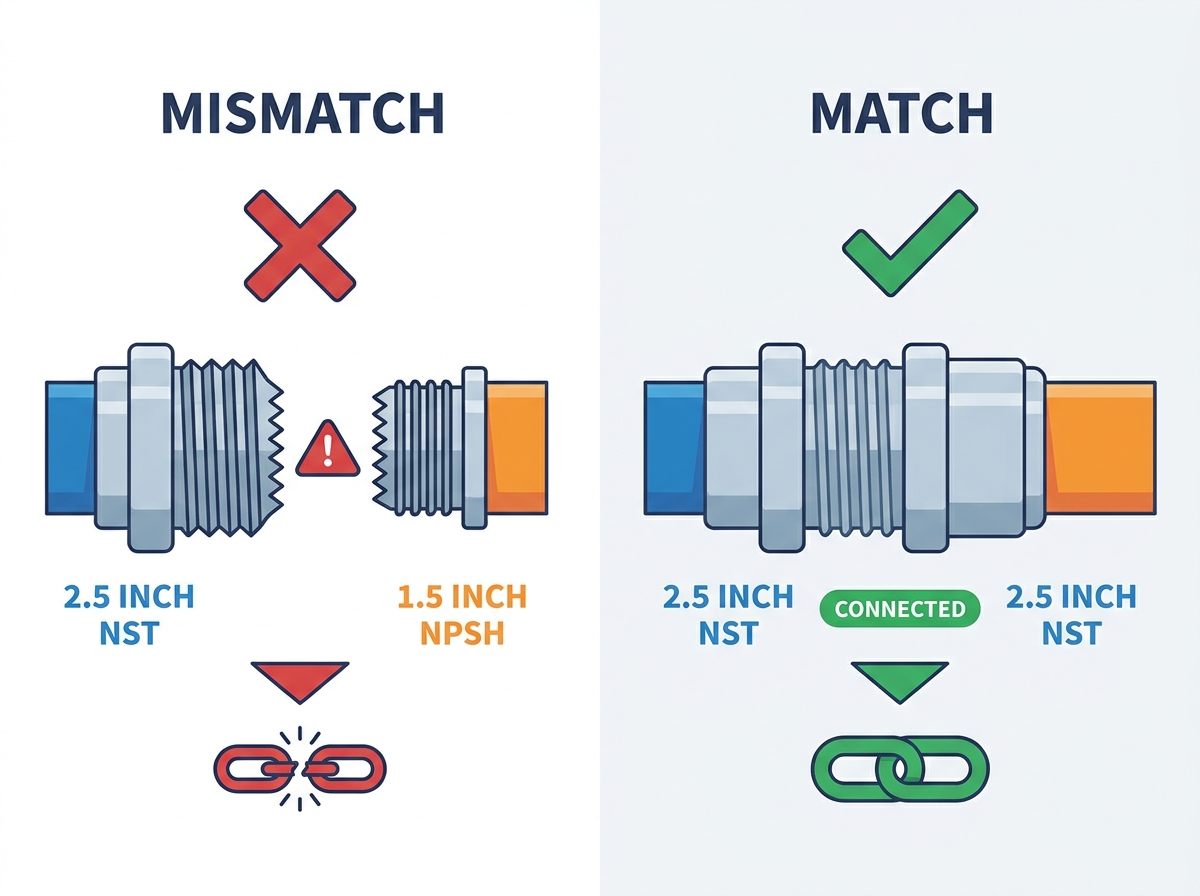
In the field, confusing your thread standards is a guaranteed recipe for operational failure. To prevent this, engineers and procurement officers must master the core specifications that govern fluid dynamics systems.
National Standard Thread, frequently referred to as National Hose, is the most prevalent thread standard in the United States fire service. Governed by strict NFPA 1963 standards, this specification utilizes a straight-thread design. Because the threads do not taper, they cannot form a seal through metal-to-metal friction. Instead, these connections require a rubber gasket seated at the base of the female coupling to create a watertight barrier. This standard is universally found on municipal fire hydrants, fire engine discharges, and standard interior attack lines.
National Pipe Tapered is the standard thread utilized in North America for plumbing and industrial fixed piping systems. Unlike standard firefighting threads, this profile features a distinct taper. As the male and female ends are threaded together, the decreasing diameter wedges the threads tightly against one another. This creates a seal through mechanical deformation and friction. These connections typically require thread sealant tape or pipe dope to prevent microscopic weeping. It is critical to understand that tapered industrial threads and straight firefighting threads are fundamentally incompatible. Attempting to mate them will inevitably result in severe equipment damage.
National Pipe Straight Hose serves as a crucial bridge between industrial piping and flexible hose applications. This standard shares the exact same threads per inch and outside diameter as standard tapered pipes, but it features a straight thread profile rather than a tapered one. It relies entirely on an internal rubber gasket to achieve a seal. Interestingly, a female straight hose coupling can successfully thread onto a male tapered pipe and seal against the pipe rim. However, a female tapered pipe cannot properly seal with a male straight hose coupling.
Core Thread Standard Comparison Table
Standard Name | Thread Profile | Sealing Mechanism | Primary Application |
|---|---|---|---|
NST / NH | Straight | Rubber Gasket | Municipal Firefighting, Hydrants |
NPT | Tapered | Thread Friction + Sealant Tape | Industrial Piping, Fixed Plumbing |
NPSH / IPT | Straight | Rubber Gasket | Industrial Washdown, Pump Discharges |
Storz | Sexless / No Threads | Internal Gasket + Interlocking Lugs | Large Diameter Hose, Rapid Deployment |
Beyond traditional threads, the industry is witnessing a massive transition toward rapid-deployment systems. The Storz connection is an innovative sexless system that abandons traditional threading entirely in favor of interlocking hooks and flanges. Invented in the late nineteenth century, this design features identical coupling halves. This means there are no distinct male or female ends. To connect them, operators simply press the two faces together and apply a quarter-turn twist until the internal locking lugs securely engage.
These mechanisms solve the dreaded thread mismatch problem entirely. Because both ends are identical, emergency responders never waste critical seconds unrolling a heavy supply line only to discover they have the wrong end facing the hydrant. The quarter-turn locking mechanism allows for significantly faster connection times compared to tedious threading. Furthermore, the sexless design eliminates the risk of cross-threading, which is a common user error when operating in dark, high-stress, or debris-filled environments. For facilities looking to upgrade, investing in sexless fire hose fittings dramatically improves deployment speed.
Selecting the correct size requires measuring the distance between the internal locking lugs, a specific metric known as the Lug Spacing or KA dimension. Common sizes include 4-inch and 5-inch variants used extensively for municipal supply lines. To ensure reliable, continuous operation, the locking mechanisms and internal seals must be kept free of grit and properly lubricated with non-petroleum-based lubricants. Many modern variants also feature external locking levers to prevent accidental disconnection when the line surges with pressure.
Accurately identifying thread sizes in the field or warehouse requires specific measurement tools. Relying on visual estimation often leads to procurement errors and dangerous operational failures. The essential toolkit includes digital calipers. These are required for precisely measuring the outside diameter of male threads and the inside diameter of female threads. You also need a thread pitch gauge, which is a specialized tool featuring serrated metal leaves used to measure the exact threads per inch. Standardized thread charts provided by the NFPA or equipment manufacturers complete the toolkit.
To ensure accurate identification, follow a standardized operating procedure. First, open the digital calipers and place them over the widest part of the male threads. Ensure the tool is perfectly perpendicular to avoid skewed readings. Next, press the leaves of the thread pitch gauge against the male threads until you find the leaf that meshes perfectly without any daylight showing through. The number stamped on that leaf is your thread count. After that, visually inspect the profile to see if the diameter decreases toward the tip, which indicates a tapered thread. Finally, cross-reference your recorded measurements with a standard reference chart to confirm the exact specification.
Even with the right tools, operators frequently make critical errors during assembly and deployment. One of the most dangerous errors in fluid transfer operations is attempting to force incompatible thread standards together. Because the thread pitches and profiles physically differ, applying excessive force with a heavy spanner wrench will cause galling. This form of severe adhesive wear aggressively strips the metal threads. It destroys the structural integrity of the metal and creates a weak connection that is highly susceptible to explosive blow-offs when the line is finally pressurized.
In straight-thread systems, the mechanical threads do not hold the water back. They merely hold the metal faces together. The actual sealing mechanism relies entirely on the internal rubber gasket. Missing, dry-rotted, or incorrectly sized gaskets are the primary cause of weeping and pressure loss at the connection point. Over time, rubber suffers from compression set and chemical degradation, losing its essential elasticity. Facilities must implement routine inspection schedules to replace any seals that show signs of cracking or permanent deformation.
A widespread misconception among operators is that tighter connections are inherently more secure. In reality, over-tightening straight-thread connections with long-handled spanner wrenches causes severe mechanical deformation. If a straight-thread fitting leaks, it is usually a gasket issue, not a torque issue. Over-torquing crushes the internal rubber beyond its elastic limit, causing it to extrude into the waterway and break the seal. Moreover, excessive torque can warp the female swivel, binding the internal ball bearings and making it nearly impossible to disconnect the hose safely post-operation.
The fragmentation of connection sizes is a historical artifact of the nineteenth century. Before national standardization efforts took root, nearly every major city engineered its own proprietary thread profiles based on local manufacturing capabilities. The devastating consequences of this fragmentation were highlighted during the Great Baltimore Fire of 1904. Responding departments from neighboring cities arrived to assist, only to stand by helplessly because their hoses could not interface with the local hydrants. While this disaster spurred the adoption of national standards, many legacy systems remain active today due to the prohibitive cost of retrofitting subterranean municipal infrastructure.
Procurement managers often fall into the logistical trap of assuming that national standards apply universally across the entire country. However, major municipalities including New York City, Chicago, and Phoenix still utilize proprietary, non-standard threads for their hydrants and standpipes. Purchasing standard equipment for a facility located in a jurisdiction with proprietary codes will render the equipment useless during a municipal emergency response. Always consult the local Authority Having Jurisdiction before finalizing equipment specifications.
For industrial contractors and facility managers operating across multiple jurisdictions, navigating these regional differences requires proactive planning. It is highly recommended to maintain a dedicated cache of specialized adapters. These adapters act as a crucial bridge, featuring the local municipal thread on one side and the national standard on the other. This ensures that standard facility hoses can interface seamlessly with local municipal water supplies regardless of the specific jurisdiction.
Determining the exact requirements depends heavily on the operational environment, fluid type, and required flow rates. Municipal firefighting demands heavy-duty, standardized equipment designed for rapid deployment, high impact resistance, and strict regulatory compliance. In contrast, industrial fluid transfer in agriculture, mining, or chemical processing often requires varied thread types like Camlock fittings or specialized stainless steel components to withstand abrasive slurries.
When specifying industrial fire hose connectors, engineering parameters dictate performance. For instance, premium couplings forged from A356-T6 aluminum alloy typically offer a working pressure of 16 Bar and a burst pressure exceeding 48 Bar. If you are selecting a Storz fitting for a large diameter hose, you must verify the lug spacing. Standard parameters dictate a 66mm KA dimension for 1.5-inch lines, an 89mm KA dimension for 2.5-inch lines, and a 133mm KA dimension for massive 4-inch supply lines. Matching these exact engineering specifications prevents operational failure.
The structural reliability of a fluid transfer system is only as strong as its weakest connection point. Sourcing equipment from unverified suppliers drastically increases the risk of machining defects, porous metal casting, and thread tolerance failures. Working with a trusted manufacturer ensures you receive equipment that strictly meets international manufacturing guidelines. Reputable manufacturers utilize precision CNC machining to guarantee flawless thread compatibility, robust swivel operation, and long-term operational safety.
Conclusion
Understanding thread standards and connection profiles prevents dangerous and costly mismatches in the field. Connection failures are entirely preventable through proper education, accurate measurement, and strict adherence to local regulations. We strongly encourage safety officers and facility managers to audit their current hose inventory regularly, replace worn rubber gaskets before they fail, and invest in the correct adapters. To guarantee a seamless, leak-free response when emergencies strike, always source your critical components from a reliable fire hose coupling manufacturer that prioritizes precision engineering and rigorous hydrostatic testing.
FAQ
NST is a straight thread design primarily used in firefighting applications. Because the threads do not taper, this standard requires an internal rubber gasket to create a watertight seal. NPT is a tapered thread design commonly used in industrial plumbing and fixed piping. It creates a seal through the mechanical friction and wedging of the threads themselves, often assisted by thread sealant tape. These two standards are entirely incompatible and cannot be threaded together.
You cannot thread them together directly without causing severe damage. To convert an industrial tapered pipe to a firefighting straight thread, you must install a specialized brass or aluminum adapter. This adapter will feature a female NPT thread on one end to attach to the plumbing pipe, and a male NST thread on the other end to allow standard fire hoses to connect seamlessly.
You cannot connect them directly. A standard residential garden hose utilizes Garden Hose Thread and typically has an internal diameter of five-eighths or three-quarters of an inch. A 2.5-inch fire hose utilizes much larger threads. To bridge this gap, you must use a specific series of step-down adapters, ensuring water pressure is properly regulated at the source to avoid bursting the smaller residential hose.
Most commercial buildings equipped with interior standpipe systems utilize either 1.5-inch or 2.5-inch hose connections. The 1.5-inch connections are typically designed for trained building occupants to use during early-stage fire suppression. The larger 2.5-inch valves are strictly reserved for professional fire department personnel to connect their heavy-duty attack lines.
Storz connections are visually distinct from traditional threaded fittings. They are sexless, meaning there are no distinct male or female ends. Both hose ends look identical. A Storz fitting features a smooth face with two or three interlocking metal hooks and corresponding grooved flanges. They connect by pushing the two faces together and twisting a quarter-turn until the lugs lock securely into place, rather than rotating on a continuous spiral thread.
The cause of the leak depends heavily on the thread standard you are utilizing. If you are using straight-thread fittings, a leak almost always indicates an issue with the internal rubber gasket. It may be missing, dry-rotted, crushed from over-tightening, or improperly seated. If you are using tapered pipe threads, a leak indicates that the threads are worn, cross-threaded, or require the application of fresh thread sealant tape to fill microscopic gaps in the metal.


