
Views: 0 Author: Site Editor Publish Time: 2026-10-27 Origin: Site
Industrial fires are unforgiving. When a facility faces a massive chemical flare-up or a fuel-based emergency, the speed and scale of your initial response dictate the survival of both personnel and operational assets. In such volatile environments, standard firefighting gear simply fails. The situation mandates heavy-duty, high-capacity suppression. Facility managers often find themselves at a crossroads during the planning phase. They struggle to determine whether their site requirements lean toward portable or fixed suppression systems. Making an incorrect decision here creates dangerous coverage gaps, leaving critical zones entirely vulnerable.
This guide breaks down the fundamental engineering differences between these two approaches. By understanding the mechanical nuances and tactical advantages of each fire monitor type, you will be equipped to fortify your facility against catastrophic disasters and ensure comprehensive site safety.
At its core, a fire monitor is an industrial-grade, aimable water cannon. It is engineered specifically to combat blazes that far outpace the capacity of traditional handheld fire hoses. These units deliver massive volumes of water or foam at high velocities. This provides the immense cooling power necessary to control large-scale thermal events.
While models vary in scale, most industrial monitors share a set of critical components. The base or flange acts as the primary anchor point. It provides the structural stability required to withstand severe recoil forces. The waterway constitutes the central body where the suppression agent flows. Integrated swivel joints grant operators the freedom to aim the stream with pinpoint precision. Furthermore, sophisticated control valves manage the pressure output. This allows the nozzle to shape the discharge into a concentrated straight stream for maximum distance or a wide-angle fog pattern for rapid heat absorption.
The efficacy of a monitor relies heavily on fluid dynamics. By channeling high-pressure flow through a constricted nozzle orifice, the system maximizes the kinetic energy of the stream. This enables the agent to penetrate deep into an active fire core. Modern industrial units typically operate at working pressures between 0.8 and 1.2 MPa. This mechanical design is crucial. It allows response teams to stand at a safer distance while maintaining the high flow rates required to overwhelm a fire's heat release rate. Recent advancements in waterway design have significantly improved laminar flow. This reduces internal turbulence and allows for a consistent, long-range reach exceeding 60 meters even in windy industrial conditions.
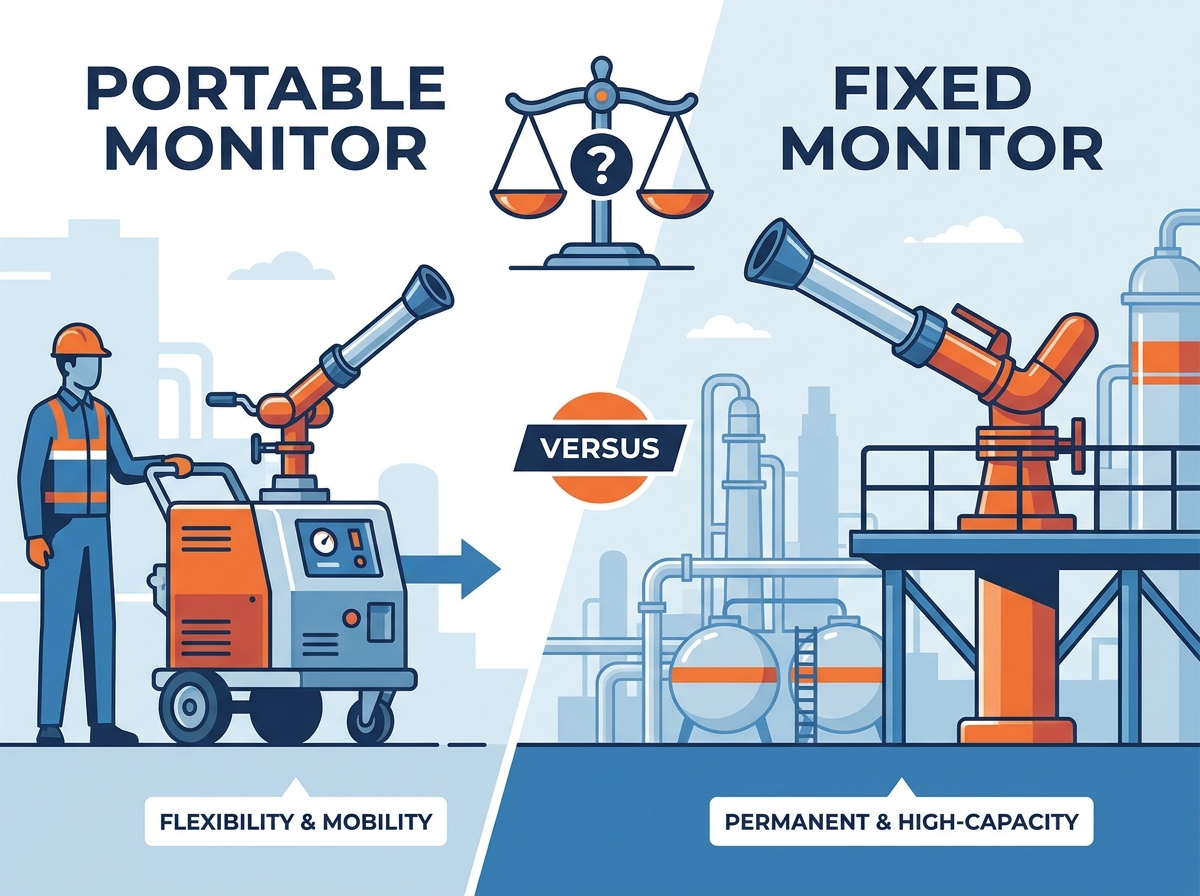
Portable units function as tactical, rapid-deployment assets for emergency response. Because they are lightweight and ground-based, they offer a level of agility that fixed systems cannot match. A single responder or a small team can rapidly maneuver these units to the edge of a hot zone, connect them to a nearby water source, and initiate a concentrated attack in mere minutes.
These devices are indispensable when your facility deals with unpredictable hazard zones. If a fire breaks out in a sprawling storage yard or an area where inventory shifts frequently, installing permanent piping at every potential ignition point is financially and logistically impractical. In such dynamic scenarios, a portable fire monitor bridges the gap between limited handlines and full-scale permanent infrastructure. It empowers emergency teams to shift the suppression stream wherever the blaze migrates.
Tactical success begins with proper setup. First, select a firm, level surface for the base to ensure optimal stability. Once positioned, verify that the integrated ground spikes are fully engaged with the terrain. This absorbs the severe nozzle reaction forces. Crucially, operators must always secure the safety tether to a permanent, heavy object. This vital step prevents the unit from moving or walking if a sudden pressure spike occurs in the supply line. After verifying that hose couplings are locked and leak-free, slowly introduce pressure to confirm the stability of the mount before pushing the system to its full rated flow.
Fixed systems represent the gold standard for high-readiness defense in extreme-risk areas. Unlike their portable counterparts, these units are permanently hard-piped directly into a facility’s fire water network. This ensures that massive suppression efforts can begin the exact second an alarm is tripped.
Regulatory standards outlined by organizations like the NFPA often mandate permanent fixed fire monitor installations in high-density hazard areas. Common applications include petrochemical loading racks, tank farms, and volatile chemical storage warehouses. The engineering logic is straightforward. In environments where a fire can grow exponentially within seconds, any time spent deploying hoses is time the fire gains ground. Fixed installations eliminate this deployment lag entirely.
Choosing between manual and automatic operation often comes down to the specific nature of the hazard. Manual units, adjusted via heavy-duty handwheels or tillers, are highly cost-effective and completely immune to power failures. This makes them perfect for less volatile zones. Conversely, remote-controlled automatic systems are essential for areas too hazardous for human approach. While these automated solutions require more complex maintenance and power integration, their ability to be operated from a secure distant command center significantly increases the safety margin for your frontline staff during a full-scale emergency.
To determine the best fit for your facility, you must compare the two options based on your site's unique operational profile. While portable monitors offer unmatched mobility, fixed units provide the raw, reliable power required for static, high-volume threats.
Feature | Portable Fire Monitor | Fixed Fire Monitor |
|---|---|---|
Deployment Speed | Tactical, manual setup required | Instantaneous, often automated |
Flow Capacity | High, typically up to 80 L/s | Extremely High, up to 120 L/s or more |
Cost Profile | Lower initial investment | Higher due to piping and installation |
Primary Use Case | Unpredictable, shifting dynamic fires | Static, high-risk hazard zones |
Looking at current industry trends, the fire protection sector is experiencing a massive shift toward Smart Firefighting. Large-scale industrial facilities are increasingly integrating fixed monitors with advanced infrared flame sensors and thermal imaging cameras. This allows the system to target and trigger automatically before human intervention is even possible. This trend towards automation drastically reduces human exposure to extreme thermal radiation. However, safety engineers still strongly recommend a hybrid approach. Keeping portable monitors in reserve serves as a critical secondary line of defense should the primary fixed system suffer damage or the fire spread beyond the fixed coverage zone.
The operational longevity of your equipment is directly tied to its metallurgy. Industrial sites are notoriously harsh, corrosive environments. Choosing the wrong material can lead to seized swivel joints or catastrophic pressure leaks right when you need the equipment most.
Aluminum alloy is the premier choice for portable equipment due to its low density. This makes maneuvering across a cluttered plant floor far easier for a single operator. For fixed installations, Brass or Bronze serves as the traditional standard. These metals offer exceptional resistance to saltwater corrosion and mechanical wear, though they are far too heavy for mobile use. For the most demanding environments like chemical processing plants or offshore drilling platforms, Stainless Steel SS304 or SS316 is the absolute gold standard. It provides unparalleled protection against pitting and aggressive chemical degradation. By matching the specific alloy to your facility's atmospheric risks, you ensure your safety investment provides decades of reliable service rather than failing after a few short years of environmental exposure.
Procurement must always begin with a rigorous fire risk assessment. If your hazards are static, such as a fuel storage terminal, the choice is clear. Prioritize fixed systems that cover every square foot of the defined danger zone. If your facility is an expansive, multi-purpose space with constantly changing risks, invest in a fleet of portable units that can be relocated as your logistical needs evolve.
Furthermore, never overlook your existing water infrastructure. A high capacity fire monitor is completely ineffective if your site's water supply piping cannot sustain the required flow rate. A standard industrial unit requires robust pump systems capable of delivering 24 to 120 liters per second. You must meticulously calculate friction loss across your piping network and ensure your hydrant density is sufficient to support the specific monitors you intend to deploy.
Reliability requires strict engineering discipline. Because fire monitors often spend long periods in standby mode, internal components can seize and rubber seals can dry out without warning. For portable systems, frontline operators must create a routine that includes post-use flushing with fresh water to strip away corrosive chemical foam residue. This should be paired with a monthly mechanical check of the folding legs and ground spikes to detect any structural deformation.
For fixed installations, annual maintenance is non-negotiable. Maintenance teams must lubricate all swivel joints with industrial-grade grease, inspect flange connections for signs of galvanic corrosion, and test all electronic control actuators. In colder climates, implementing strict winterization protocols is vital. Ensure no residual water remains trapped in the waterway, as freezing temperatures will expand the water and rupture the unit’s heavy metal casing.
There is no single correct solution for industrial fire protection. The most resilient strategy is always a hybrid one. By securing known high-risk areas with heavy-duty fixed monitors and supplementing them with portable systems to cover unpredictable gaps, you create a layered, fail-safe defense network. The best time to audit your fire suppression capabilities is long before an emergency arises. Take the time to assess your facility today. For industry-leading suppression equipment, explore the full range of solutions at NBDHST to find the exact specifications and premium builds your site demands.
Flow rates are highly variable based on engineering design. Standard portable monitors typically output between 500 and 1,000 gallons per minute, providing a massive tactical upgrade over handheld hoses. Heavy-duty fixed systems common in petrochemical environments often range from 1,000 to over 2,000 gallons per minute, with specialized ultra-high-capacity systems capable of exceeding 5,000 gallons per minute.
Yes, modern high-end portable monitors are specifically designed for unattended operation. They feature advanced stabilization bases, aggressive ground-anchoring spikes, and safety tethers that perfectly counteract extreme nozzle reaction forces. Many premium units even include automatic safety valves that instantly shut down water flow if the monitor loses its footing.
While local municipal codes vary, facility managers should perform a comprehensive visual inspection at least once a month to check for external damage, corrosion, or debris clogs. A full operational flow test where you actually discharge water under pressure and sweep through the full range of motion must be conducted annually as stipulated by NFPA guidelines.
In the strict context of industrial fire safety, these terms are synonymous. Fire monitor is the professional, technical term preferred by safety engineers and NFPA standards. Water cannon is a more colloquial term often applied to a wider range of equipment, including units used in mining dust suppression, agriculture, or riot control.
Absolutely. The kinetic energy generated by a monitor flowing at high pressure is immense and potentially lethal. Operators must be rigorously trained to manage nozzle reaction forces to prevent the device from becoming unstable. Training is also required to understand the prevention of water hammer, a dangerous pressure surge that occurs when valves are closed too quickly, which can violently destroy underground supply lines.
Throw distance depends heavily on the operating pressure and the nozzle design. Standard industrial models typically achieve a reach of 50 to 80 meters. Ultra-high-capacity fixed systems operating at peak pressure can exceed 100 meters. This extended reach is critical because it allows operators or automated sensors to suppress the fire while remaining safely outside the dangerous radiant heat zone.
To calculate the required water supply, engineers determine the total flow rate needed for the specific hazard area. They then multiply this flow rate by the mandatory operational duration, which is usually 2 to 4 hours according to NFPA standards. Finally, they factor in friction loss across the entire piping network to ensure the fire pumps can sustain the required pressure at the monitor's inlet flange.


