
Views: 0 Author: Site Editor Publish Time: 2026-11-23 Origin: Site
In emergency suppression and industrial fluid transfer, a mismatched connection is a point of failure. The inability to connect a hose to a hydrant, pump, nozzle, or standpipe due to incompatible threading halts operations instantly. Procurement teams and safety engineers face a fragmented market of regional thread standards, sexless couplings, and proprietary connections. Specifying the wrong adapter leads to pressure leaks, cross-threading damage, and non-compliance with safety regulations.
You can mitigate these risks through a systematic approach to evaluating connection types. This guide details the technical criteria for specifying a fire hose adapter. We compare thread standards, material tolerances, downstream equipment compatibility, and manufacturer validation processes to ensure your facility maintains operational readiness at all times.
Identify the Exact Thread Standard: Compatibility extends beyond mere diameter; matching the specific thread pitch (e.g., NH/NST vs. NPSH) or coupling style (e.g., Storz, BS336) is mandatory to prevent blow-offs under high working pressure.
System-Wide Verification: A successful connection requires verifying compatibility not just between hoses, but across the entire fluid path, including hydrants, wye valves, and nozzles.
Material Dictates Application: The choice between extruded aluminum, forged brass, and stainless steel must align with the operational environment, balancing weight requirements against corrosion resistance and durability.
Validate Manufacturer Credentials: Sourcing from a certified fire hose coupling manufacturer ensures adapters meet stringent hydrostatic testing and dimensional tolerance standards required by NFPA or equivalent international bodies.
Gasket and Seal Integrity: A fire hose adapter is only as reliable as its gasket profile; evaluating the elastomer material against expected temperature ranges and chemical exposure is a critical, often overlooked step.
Buyers frequently make a procurement error by assuming the hose inside diameter (ID) dictates the thread size. Specifying a 2.5-inch adapter based solely on a 2.5-inch hose ID will result in an incompatible connection. Thread standards rely entirely on the Outside Diameter (OD) of the male fitting. For example, a standard 2.5-inch National Hose (NH) thread actually has an OD of approximately 3.0686 inches.
To accurately specify a fire hose thread size adapter, field technicians must measure the male thread OD using digital calipers. Follow these exact steps to ensure accuracy:
Clean the threads thoroughly with a wire brush to remove dirt, scale, or old pipe dope.
Place the digital caliper jaws across the widest section of the male threads.
Rotate the fitting 90 degrees and measure again to check for out-of-roundness caused by impact damage.
Use a thread pitch gauge to count the exact Threads Per Inch (TPI).
Cross-reference the precise OD and TPI against established thread charts to determine the exact specification required before placing an order. Guessing the thread pitch based on visual inspection guarantees failure in the field.
Adapters must match or exceed the maximum working pressure of the attached hose and pumping apparatus. Standard municipal fire hoses operate at 150 to 300 PSI, but industrial applications push these limits much higher. The success criteria for pressure ratings demand that the adapter maintains structural integrity without deformation or leakage under maximum load.
Pressure surges, commonly known as water hammer, pose a severe risk to fluid transfer systems. Rapid valve closures send shockwaves through the line, multiplying the static pressure exponentially. Adapters must possess a burst pressure safety margin—typically two to three times the rated working pressure—to survive these kinetic events. Verifying batch hydrostatic testing records ensures the adapter can withstand sudden pressure spikes. During a hydrostatic test, technicians fill the assembly with water, bleed all air, and raise the pressure to the test rating for one to three minutes to confirm zero leakage.
Threaded connections rely entirely on gaskets to maintain a watertight seal. Face seals sit at the base of the female coupling, compressing against the flat edge of the male thread. Expansion ring gaskets secure the hose bowl to the coupling body. If the gasket profile is too thin, the connection will leak under pressure. If it is too thick, the threads will not engage fully, risking a dangerous blow-off.
Selecting the correct elastomer material is required for industrial or chemical environments. Standard natural rubber degrades rapidly when exposed to petrochemicals, ozone, or extreme temperatures. You must match the gasket material to the fluid being transferred.
Gasket Material | Temperature Range | Chemical & Oil Resistance | Best Application |
|---|---|---|---|
EPDM | -40°F to 212°F | Poor | Municipal water, outdoor weathering |
Nitrile (Buna-N) | -30°F to 200°F | Excellent | Refineries, industrial plants, offshore |
Neoprene | -20°F to 180°F | Moderate | General maritime use, mixed environments |
Teflon (PTFE) | -100°F to 400°F | Outstanding | Aggressive chemical transfer, high heat |
Compatibility extends far beyond joining two hoses. An adapter must seat correctly against the specific internal machining of downstream equipment, including nozzles, wye valves, and hydrant spigots. Mismatched internal waterways create turbulence, increasing friction loss and reducing the effective reach of the fire stream.
When adapting a large-diameter supply line to smaller attack lines via a wye valve, the adapter must not obstruct the valve's ball mechanism. High-quality adapters feature a Higbee cut—a blunt starting thread that prevents cross-threading. The corresponding Higbee indicator is a notch on the lug that aligns with the start of the thread. Field crews use this indicator to connect hoses rapidly in zero visibility. If the adapter lacks a properly machined Higbee cut, it slows down deployment and increases the risk of thread damage.
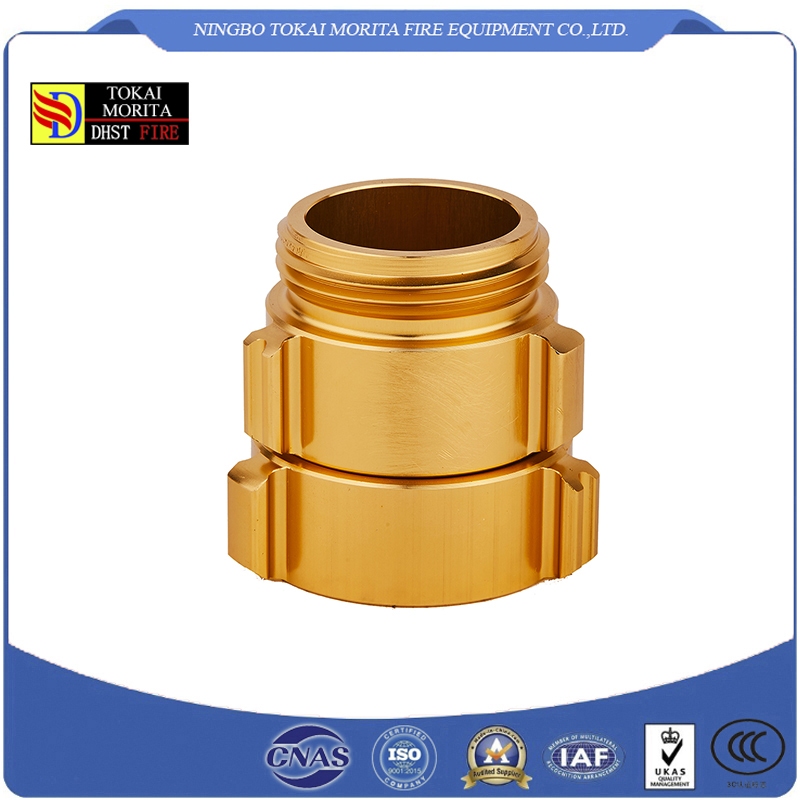
National Hose (NH), also known as National Standard Thread (NST), serves as the primary fire hose thread standard across North America. Established by the NFPA, NH/NST utilizes a straight thread profile that seals via a compressed gasket rather than thread interference. This design allows for rapid coupling by hand without the need for pipe dope or Teflon tape.
A severe hazard arises from the incompatibility between NH/NST and National Pipe Straight Hose (NPSH) or National Pipe Thread (NPT). NPT utilizes a tapered thread that seals through metal-to-metal wedging on the thread flank. Forcing an NH female onto an NPT male will strip the threads and cause severe leaking. Bridging these disparate systems requires a precision-machined NH NST fire hose adapter designed specifically to transition from straight gasket seals to tapered pipe threads safely.
Large-diameter hoses (LDH) utilized for high-volume water supply rely heavily on Storz connections. The mechanical advantage of a Storz fire hose adapter lies in its sexless, quarter-turn design. Because there are no male or female ends, any two Storz couplings of the same size can connect instantly. This eliminates the time wasted aligning threads during rapid deployment.
Evaluating Storz adapters requires inspecting the locking mechanisms and lug durability. High-pressure applications demand Storz couplings equipped with locking levers to prevent accidental disconnection caused by hose torque. The exact dimension for Storz compatibility is the "Ka" distance—the measurement between the inside locking lugs. A 4-inch Storz coupling will only mate with another 4-inch Storz coupling sharing the identical lug distance. Furthermore, always specify forged Storz heads over cast versions. Cast aluminum contains microscopic air pockets that fracture under water hammer, whereas forged aluminum compresses the grain structure for vastly superior tensile strength.
In the UK, Commonwealth nations, and the global maritime sector, the British Standard (BS336) instantaneous coupling dominates. Unlike threaded connections, the BS336 John Morris adapter utilizes a push-in mechanism where the male lip snaps securely into the female catch. This allows for immediate connection simply by pushing the two halves together.
The pull-release mechanism on a 2.5 inch instantaneous hose adapter features spring-loaded catches that release the male end when pulled outward. While highly efficient, this design requires strict maintenance in high-debris environments. Sand, grit, or dried saltwater can jam the internal spring mechanism, preventing a secure lock. When comparing flow characteristics, instantaneous couplings offer excellent unobstructed waterways, though their maximum pressure limitations are generally lower than heavy-duty threaded alternatives.
Non-emergency industrial use cases frequently require adapting fire suppression infrastructure for routine facility maintenance. Plant operators often attach a 1.5-inch fire hose to commercial copper tubing or compression fittings to execute high-volume line cleanouts. This requires specialized adapters that transition from coarse fire threads to fine commercial plumbing threads.
Specifying reducing adapters for facility washdown applications involves stepping down large diameters to manageable sizes. A common scenario involves adapting a 2.5-inch hydrant discharge down to a 3/4-inch standard garden hose thread (GHT). When tapping into high-pressure municipal lines for routine washdowns, operators must install pressure-reducing valves inline. Subjecting standard commercial hoses to 150 PSI hydrant pressure will rupture the hose instantly, creating a severe safety hazard for the operator.
Material selection dictates the lifespan, mobility, and structural integrity of the adapter. The trade-offs between brass and aluminum center on weight and corrosion resistance.
Forged Brass: Offers superior corrosion resistance and exceptional durability. It withstands mechanical impact and resists galling. Brass is the mandatory choice for fixed maritime environments, offshore platforms, and industrial standpipes where saltwater or chemical exposure is constant. The primary drawback is a significant weight penalty, which increases operator fatigue during manual deployment.
Extruded Aluminum: Hard-coated extruded aluminum dominates municipal firefighting. It provides a massive weight reduction, allowing firefighters to deploy hoses rapidly. However, aluminum requires MIL-A-8625 Type III Class 1 hardcoat anodizing to prevent galvanic corrosion and surface wear. This process creates an aluminum oxide layer harder than tool steel. If this anodized layer scratches, raw aluminum exposed to harsh water conditions will oxidize and pit over time.
Material | Weight Profile | Corrosion Resistance | Primary Application |
|---|---|---|---|
Forged Brass | Heavy | Excellent (Marine Grade) | Maritime, Fixed Standpipes, Refineries |
Extruded Aluminum | Lightweight | Good (Requires Anodization) | Municipal Firefighting, Wildland |
316 Stainless Steel | Moderate to Heavy | Superior (Chemical/Acid) | Petrochemical, Offshore Drilling |
Stainless steel adapters serve highly specialized use cases in petrochemical, offshore, and severely corrosive industrial applications. Alloys such as 316 stainless steel contain molybdenum, which prevents chloride pitting in saltwater environments. They offer unmatched resistance to aggressive chemicals, acids, and extreme thermal fluctuations that would destroy standard brass or aluminum fittings.
Specifying premium alloys requires analyzing the cost-to-lifespan ratio. Stainless steel carries a high initial procurement cost. However, in environments where brass dezincifies or aluminum corrodes within months, the extended operational lifespan of stainless steel eliminates frequent replacement costs and prevents catastrophic line failures.
Procuring adapters from unverified suppliers introduces unacceptable risk into life-safety systems. Vetting a fire hose coupling manufacturer requires strict compliance audits. Establish baseline criteria: the facility must hold ISO 9001 certification and produce fittings compliant with NFPA 1963, BS336, or carry UL/FM approvals.
Request Material Test Reports (MTRs) to verify the exact chemical composition of the metal alloys used in production. An MTR lists the heat number, chemical composition (such as copper, zinc, and lead content for brass), and mechanical properties including tensile strength and yield strength. Furthermore, demand batch hydrostatic testing documentation. Reliable manufacturers test their adapters by holding them at proof pressure for a specified duration to ensure zero deformation. Skipping this validation step drastically increases the risk of catastrophic failure during high-pressure operations.
Upgrading legacy infrastructure often reveals non-standard regional threads. Municipalities like Chicago, New York, and various regional districts utilize proprietary thread pitches that do not mate with standard NH/NST equipment. Implementing mutual aid response plans or upgrading facility hardware requires custom adaptation.
Evaluate a manufacturer's capability to produce custom adapters—such as transitioning a local proprietary thread to a standard Storz connection—without compromising structural integrity or extending lead times. A scalable supply chain ensures that custom-machined adapters undergo the same rigorous CNC tolerance checks as off-the-shelf components. A thread cut just 0.005 inches too deep will cause the gasket to seat improperly, leading to immediate leaks.
Conduct a comprehensive thread-pitch audit of all facility connection points using digital calipers and pitch gauges.
Request technical specification sheets and Material Test Reports (MTRs) from shortlisted manufacturers to verify alloy composition.
Procure sample adapters to execute physical fit-testing and hydrostatic pressure checks before authorizing bulk orders.
Implement a routine inspection schedule to check gasket integrity, lug wear, and spring mechanisms on all deployed adapters.
A: Measure the Outside Diameter (OD) of the male threads using digital calipers. Take three measurements around the circumference to account for any deformity. Use a pitch gauge to determine the exact Threads Per Inch (TPI). Compare these precise measurements against standard thread charts to identify the required adapter. Never rely on the inside diameter of the hose, as this will result in an incorrect specification.
A: No, they are not directly compatible. NH/NST uses a straight thread with a gasket seal, while NPT uses a tapered thread that seals on the threads themselves. Forcing them together will strip the threads and cause severe leaks. A specific adapter is required to transition safely between straight and tapered threads.
A: Yes, specialized reducing adapters step down a 2.5-inch hydrant outlet to a 3/4-inch garden hose thread (GHT) or commercial compression fittings. You must account for high hydrant pressure. Standard garden hoses will rupture under municipal water pressure. Always install a pressure-reducing valve inline before connecting lightweight commercial hoses to a fire hydrant.
A: A Storz adapter is a sexless, quarter-turn coupling that connects to any matching Storz fitting of the same size. This allows for rapid connections without the risk of cross-threading. Threaded adapters require aligning male and female ends and rotating them multiple times to secure the connection. Storz is generally preferred for large-diameter supply lines.
A: Generally, adapters manufactured strictly to the BS336 standard are interchangeable. You must verify the material tolerances and pressure ratings. Sub-standard manufacturing leads to poor seating, jammed release mechanisms, and dangerous leaks. Always source from manufacturers that provide batch hydrostatic testing records to ensure the fittings meet the required safety margins.
A: The choice depends on regional standards and existing infrastructure. BS336 is standard in many maritime and Commonwealth applications, offering a reliable push-in connection. Storz is preferred in North America and Europe primarily for large-diameter supply lines. You should match the adapter style to the equipment already deployed in your facility or local response district.
A: Look for documented compliance with standards like NFPA 1963 or BS336. Request transparent material sourcing via Material Test Reports (MTRs). Verify they have in-house hydrostatic testing capabilities. The manufacturer must consistently provide precise CNC-machined dimensional tolerances to ensure the adapters seat correctly and maintain a watertight seal under maximum working pressure.


