


Views: 0 Author: Site Editor Publish Time: 2026-08-25 Origin: Site
Suppressing fires in concealed, barricaded, or heavily fortified spaces presents a severe tactical challenge for any engine company. Direct access is often impossible or structurally hazardous. Traditional direct-attack methods have severe limitations when dealing with void spaces. Breaching walls, floors, or vehicle hoods to apply water exposes firefighters to backdrafts, flashovers, and structural collapse. It also delays critical temperature reduction while crews struggle with hand tools. This evaluation compares the specialized capabilities of a piercing fire nozzle against the high-volume reliability of a standard handline. We establish clear criteria for when each tool is tactically necessary on the fireground. You will learn how to evaluate deployment contexts, manage operational trade-offs, and improve crew safety during indirect attacks.
Deployment Context: Standard nozzles are mandatory for high-GPM, direct-attack scenarios requiring maximum reach and volume, whereas piercing nozzles are specialized tools for indirect attack in confined, inaccessible spaces or from adjacent rooms.
Safety and Exposure: Piercing nozzles significantly reduce firefighter exposure to extreme thermal events by allowing water application through physical barriers (walls, floors, vehicle hoods) prior to entry, effectively cooling the environment without introducing oxygen.
Operational Trade-offs: The primary limitation of a piercing nozzle is its lower Gallons Per Minute (GPM) output and lack of stream reach compared to a straight stream fire nozzle, making it unsuitable for fully involved, open-room fires.
Specialty Applications: Piercing tools excel in highly specific scenarios, such as attic fires, basement fires, and chimney fires, where rapid compartment cooling is required before a physical breach.
Structural firefighting requires establishing baseline success criteria for suppression operations. These criteria include rapid heat absorption, high-volume water delivery, and deep stream penetration. A standard fire hose nozzle serves as the primary weapon for interior fire attack. It delivers the necessary volume to overwhelm massive fire loads. Understanding these baseline capabilities helps company officers identify exactly when specialized tools become necessary on the fireground.
Traditional handlines operate through distinct mechanical principles based on their tip design. Smooth bore tips feature a tapered cylindrical waterway that produces a solid column of water. This design maximizes penetration through dense thermal layers and minimizes air entrainment, which prevents disrupting the thermal balance in a room. Combination nozzles, often called fog nozzles, utilize a spinning turbine or fixed teeth to break the water stream into smaller droplets. This mechanical action creates varying patterns depending on the bumper adjustment.
Firefighters select patterns based on immediate tactical needs at the door. A wide fog pattern absorbs heat rapidly and assists in hydraulic ventilation when placed near a window. A straight stream setting mimics a smooth bore, providing concentrated reach and penetration. These variable mechanics make standard handlines highly versatile for open-compartment firefighting. They allow crews to transition seamlessly from cooling the upper gas layer to directly attacking the seat of the fire. Pump operators must calculate friction loss accurately to ensure the tip receives the correct pressure, typically 50 PSI for smooth bores and 75 to 100 PSI for fog patterns.
High fire loads demand high flow rates. Interior attack lines typically flow between 150 and 250 Gallons Per Minute (GPM). This massive volume is necessary to overcome the heat release rate of modern synthetic furnishings, which burn hotter and faster than legacy materials. High-flow handlines deliver this volume efficiently. Regular low-flow tips simply struggle to provide sufficient cooling capacity in fully involved residential or commercial structures.
Stream reach is equally critical for firefighter safety. A straight stream fire nozzle maximizes standoff distance. It allows crews to knock down flames from the hallway before entering the fire room. This reach penetrates deep-seated fires and disrupts the thermal layer from a safe position. Massive fire loads absolutely demand the superior reach and volume of conventional high-flow lines. Without adequate GPM, the water simply converts to steam before reaching the burning material, leaving the crew exposed to punishing heat.
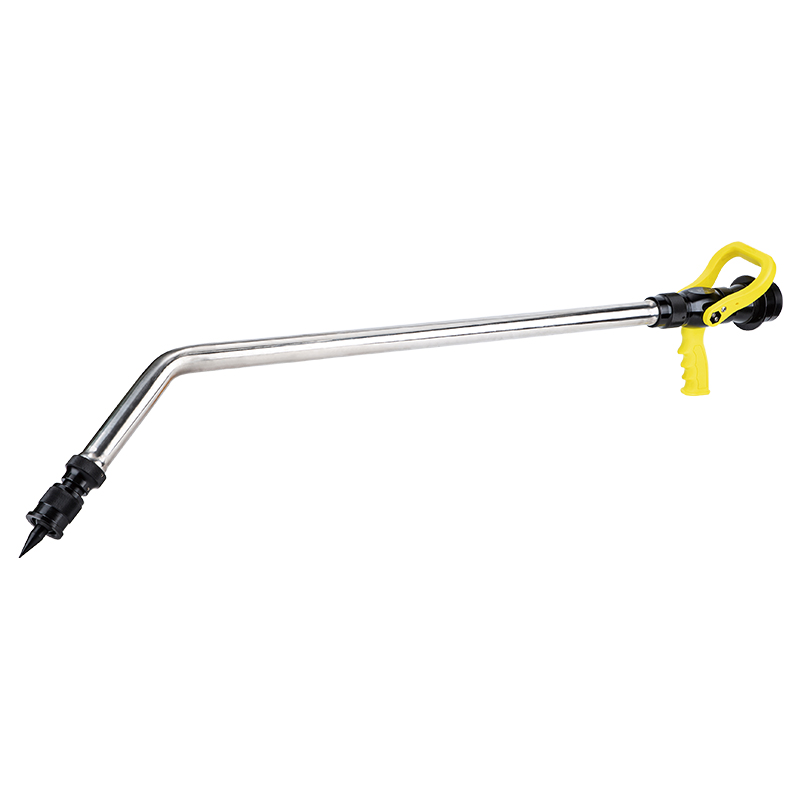
Specialized fireground problems require specialized equipment. A piercing tool falls under the broader category of a specialty fire nozzle. It solves the specific problem of inaccessible fires. Instead of relying on open space and clear lines of sight, this tool uses physical force to create its own access point. It delivers water directly into concealed voids where standard handlines cannot reach.
Piercing tools feature robust structural engineering designed for heavy abuse. Manufacturers construct them from hardened tool steel or heavy-duty aircraft-grade aluminum. The design includes a solid driving block at the base of the tube. This block withstands repeated strikes from a sledgehammer, flathead axe, or maul. The tip features a hardened, pointed striking head designed to pierce building materials without deforming.
This construction allows the tool to breach tough materials encountered during structural firefighting. Firefighters can drive it through cinder block walls, interior drywall, corrugated sheet metal, and heavy roof decking. Once breached, the nozzle head enters the concealed space. The tip contains multiple precisely machined orifices. These orifices create a 360-degree radial spray pattern. This specific water distribution pattern maximizes surface area coverage within the confined space, ensuring water hits all sides of the void.
Piercing tools operate with distinct flow characteristics that differ entirely from standard handlines. They typically deliver flow rates between 90 and 125 GPM at 100 PSI nozzle pressure. This lower volume is intentional. It matches the confined nature of the spaces they target, preventing excessive water weight accumulation. However, this reduced GPM presents a strict operational limitation. It cannot overcome the heat release rate of a large, open-room fire.
The radial spray pattern also lacks stream reach. The water atomizes immediately upon exiting the tip. It creates a dense fog localized entirely around the nozzle head. This limits physical penetration into deep-seated fire loads. The tool relies entirely on steam conversion within a small compartment rather than direct water application over a distance. Pump operators must understand these flow limitations to avoid over-pressurizing the line or expecting knockdown power the tool cannot provide.
Comparing these tools requires evaluating them across critical fireground metrics. Fire officers must understand how each device performs regarding accessibility, safety, and application efficiency. Choosing the wrong tool for the tactical dimension can compromise the entire operation and put members at risk.
Standard handlines require a clear line of sight. Firefighters must physically open doors or breach walls with hand tools to apply water. This action introduces fresh oxygen into the fire compartment. It risks ventilation-induced flashovers. Pushing into a concealed space with a standard line often requires extensive overhaul and destruction before suppression even begins, allowing the fire to grow during the delay.
Piercing tools solve this accessibility problem. They allow for water application through intact barriers. A crew can drive the tool through a floor directly into a burning basement. This adjacent room tactic is highly effective. It allows firefighters to introduce water into a confined space from a safe, uncompromised area. They can suppress a barricaded fire room without ever opening the door or breaking a window.
Prolonged breaching operations expose crews to severe risks. Cutting through roofs or floors with chainsaws to gain standard access takes time. It increases the risk of structural collapse as fire attacks the structural members below. It also places firefighters directly in the exhaust portion of the flow path. The heat and toxic gases vent directly toward the operating crew once the hole is opened.
Piercing tools facilitate safe transitional attacks. By leaving the physical barrier intact, they maintain flow path control. The radial spray lowers compartment temperatures rapidly. It starves the fire of oxygen while converting the existing heat into steam. This process dramatically improves conditions before interior crews make physical entry, reducing the likelihood of thermal burns.
High-flow standard handlines can cause excessive water damage if not managed properly. Delivering 200 GPM into a localized void space quickly floods the area. Much of this water runs off without absorbing heat, pooling on floors and leaking through ceilings. This inefficiency increases property damage and adds unnecessary water weight to compromised structures, increasing collapse potential.
Piercing tools offer superior application efficiency in confined spaces. The atomized, radial spray maximizes the water droplet surface area. This allows the water to convert to steam almost instantly upon contacting the superheated atmosphere. The steam expands and smothers the fire. This efficient conversion minimizes water runoff and significantly reduces collateral property damage.
Tactical Deployment Comparison Matrix
Deployment Metric |
Piercing Tool |
Standard Handline |
|---|---|---|
Primary Use Case |
Concealed spaces, indirect attack |
Open compartments, direct attack |
Flow Rate (GPM) |
90 - 125 GPM |
150 - 250+ GPM |
Stream Reach |
Zero (Radial Spray) |
High (Penetrates thermal layers) |
Flow Path Control |
Excellent (Maintains intact barriers) |
Poor (Requires opening doors/walls) |
Setup Time |
Slower (Requires striking tools) |
Fast (Immediate deployment) |
Water Damage |
Minimal (High steam conversion) |
High (Significant runoff potential) |
Standard handlines handle the majority of structural fires. However, certain scenarios render them ineffective or highly dangerous. Specialty tools bridge this tactical gap. They provide specific solutions for unique fireground challenges where traditional methods fail.
Attic and basement fires present severe access challenges. Pushing up a narrow staircase into a superheated attic with a standard line is punishing. The heat banks down, and the crew takes a beating while trying to advance. Furthermore, modern lightweight truss roofs fail rapidly under fire conditions, making interior operations extremely dangerous. Pushing down interior basement stairs places crews directly in the chimney effect of the fire, absorbing all the convective heat venting upward. Both tactics result in high firefighter injury rates and slow knockdown times.
Piercing tools change this methodology entirely. Crews can drive the tube through the exterior roof decking directly into the attic space, operating from the safety of an aerial ladder or a stable roof section. For basements, they can pierce the first-floor floorboards near the exterior walls or drive through the rim joist from the outside. This achieves rapid fire knockdown. It cools the space without creating a dangerous flow path up the interior stairs.
Chimney flue fires require a delicate tactical approach. Blasting a standard stream up a chimney causes massive thermal shock. It destroys the masonry, cracks the flue tiles, and forces smoke back into the residence. A chimney fire nozzle offers a better solution. This variation is lowered down the flue from the roof using a chain or rope. It sprays a fine mist that extinguishes the fire without damaging the structure.
Similar tactics apply to void spaces. Knee walls in finished attics and partition voids in older balloon-frame construction hide traveling fires. Driving a piercing tip through the drywall directly into the void stops the fire spread instantly. It eliminates the need to pull down entire ceilings with pike poles just to find the seat of the fire.
Vehicle fires present unique hazards. Opening the hood of a burning traditional vehicle is dangerous. Heat weakens the hood struts, causing them to fail and drop the heavy metal on the firefighter. The sudden influx of oxygen can also trigger a flash fire right in the firefighter's face. Piercing the hood directly keeps the firefighter safe while flooding the engine compartment with water.
Electric Vehicle (EV) battery fires require even more specialized tactics. The lithium-ion battery packs sit beneath the chassis. They are heavily armored and prone to thermal runaway, a chemical chain reaction that produces its own oxygen and massive amounts of heat. Standard exterior hose streams simply bounce off the undercarriage armor, wasting water and failing to cool the battery cells. Emerging tactics use specialized piercing tools to penetrate the battery casing directly from beneath the vehicle. Crews slide the tool under the chassis and drive it upward into the battery pack. This floods the battery compartment directly, cooling the thermal runaway much faster than traditional methods. It reduces the thousands of gallons of water typically required for an EV fire down to a manageable volume.
Fire departments must weigh the cost of specialty equipment against the frequency of its use. Understanding the overall value requires analyzing the operational pros and cons. It also requires acknowledging the strict limitations of the equipment to prevent tactical failures on the fireground.
The advantages of piercing tools are highly specific. They offer unmatched flow path control by keeping doors and windows closed. They drastically reduce firefighter exposure to extreme heat, toxic gases, and structural collapse. They allow crews to attack fires from safe, adjacent rooms. Their atomized spray provides highly efficient steam conversion in confined areas, maximizing the cooling power of every drop of water.
The disadvantages are equally distinct. They suffer from restricted GPM output, making them useless for large fires. They possess zero stream reach, requiring the tool to be placed exactly where the fire is located. Deployment relies entirely on physical force and striking tools, which fatigues the operator. They are useless in a large, open-room fire where reach and volume are mandatory for survival.
Deploying a piercing tool in the wrong environment carries critical risks. If the fire load exceeds the tool's cooling capacity, the operation will fail. A fully involved attic fire that has burned through the roof cannot be suppressed with 100 GPM of radial spray. The fire will simply overpower the water application.
These massive fires absolutely require the GPM and stream reach of a standard handline. Fire officers must recognize this GPM deficit early in the incident. They must transition to high-flow standard lines immediately if the piercing tactic does not achieve rapid temperature reduction within the first minute of water application.
Effective deployment requires specific training. Firefighters must accurately identify deployment points. They use thermal imaging cameras (TIC) to pinpoint the seat of the fire behind the wall or floor. Training must emphasize avoiding hidden hazards. Striking an electrical panel, a heavy structural steel beam, or a pressurized gas line will damage the tool and severely endanger the crew.
Setup time is another implementation risk. Deploying a piercing line requires coordination. Crews must bring the tube, a sledgehammer, and the hose line to the breach point. Hose line transitions take time, especially if breaking a line to insert an inline valve. Departments must drill on this setup to ensure rapid deployment during an actual incident.
Inspect the striking head after every use for blunting or micro-fractures.
Check the radial orifices for debris or hard water scale buildup.
Lubricate the threads connecting the driving block to the extension tubes.
Verify the inline shutoff valve operates smoothly under pressure.
Store the tool with the striking head protected to prevent damage in the apparatus compartment.
Purchasing specialty tools requires strict evaluation criteria. Departments cannot afford equipment failure during a breaching operation. Procurement officers must assess material quality, compliance, and vendor reliability before outfitting their apparatus.
Material durability dictates the lifespan of a piercing tool. The striking heads must meet strict metallurgical standards. Inferior steel will deform, blunt, or shatter when driven through cinder block or metal decking. Departments must specify hardened tool steel or specialized alloys for the tips to ensure they survive repeated impacts.
Compliance ensures operational safety. Procurement officers must verify that all purchased equipment meets National Fire Protection Association (NFPA) standards. Specifically, verifying NFPA 1964 compliance guarantees the device has passed rigorous pressure, flow, and durability testing required for fire service use.
Breaching Tool Material Specifications
Component |
Recommended Material |
Performance Requirement |
|---|---|---|
Striking Head |
Hardened Tool Steel |
Resist deformation against masonry and steel |
Extension Tube |
Aircraft-Grade Aluminum / Stainless Steel |
High tensile strength, corrosion resistance |
Driving Block |
Solid Steel Alloy |
Absorb sledgehammer impacts without cracking |
Inline Valve |
Brass or Heavy-Duty Aluminum |
Maintain seal at high pump discharge pressures |
Operational control is mandatory during breaching. You cannot drive a flowing tube through a wall. Therefore, pairing piercing tools with a robust fire nozzle with shutoff is an operational necessity. A high-quality ball valve or slide valve allows the firefighter to keep the water off while striking the tool, then instantly open the line once the tip breaches the void.
Selecting the right vendor ensures long-term usability. Evaluate your fire nozzle supplier based on their complete support package. Check their warranty terms for striking head deformation. Ensure replacement parts, like spare tips and driving blocks, are readily available. Request post-sale training support to integrate the new tools into your department's standard operating guidelines.
Evaluate your district's building stock and response data before making a purchase decision. If your response area features a high prevalence of basements, older balloon-frame construction, or frequent vehicle fires, specialized breaching tools provide immense tactical value.
Conduct a tactical audit of your current apparatus inventory to identify gaps in confined-space suppression capabilities.
Update your standard operating guidelines (SOGs) to include specific protocols for transitional attacks using breaching tools.
Schedule hands-on training for your crews using thermal imaging cameras to identify safe and effective breach points on acquired structures.
Request field demonstrations from a qualified supplier to test material durability against your local construction types.
A: The primary purpose is breaching physical barriers to apply a 360-degree water spray into confined, inaccessible spaces. It allows firefighters to attack fires in attics, basements, or vehicles from adjacent rooms without introducing oxygen or creating dangerous flow paths.
A: No. Piercing tools have strict GPM and reach limitations. Standard handlines are absolutely required for direct attack, massive heat absorption, and overcoming high fire loads in fully involved, open-room environments.
A: The main pros include excellent flow path control, reduced firefighter thermal exposure, and highly efficient steam conversion. The cons include restricted water volume, zero stream reach, and the physical exertion required to breach barriers.
A: A typical piercing tool flows between 90 and 125 GPM. The exact flow rate depends on the specific tip design, the orifice sizes on the striking head, and the pump discharge pressure supplied by the engine.
A: Chimney nozzles are specialized, often smaller radial tools designed specifically for flue fires. They are lowered down a chimney to spray a fine mist, extinguishing the fire rapidly without causing thermal shock or damaging the masonry structure.
A: Yes. It is an operational necessity to use an inline shutoff valve. The water must remain off while the firefighter uses a sledgehammer to drive the tool through a wall or floor, opening the valve only after breaching the space.
A: A straight stream should be used in scenarios requiring maximum reach, high GPM for massive heat absorption, and deep penetration into open, fully involved compartments where direct attack is necessary to extinguish the fire.


