
Views: 0 Author: Site Editor Publish Time: 2026-06-25 Origin: Site
Inadequate flow control introduces severe operational risks across multiple industries. Whether you manage high-stakes emergency response operations or complex commercial irrigation setups, precise water distribution remains critical. Expanding manifold outputs intuitively seems like the best approach for scaling operations. You might assume adding more lines automatically guarantees faster coverage. However, fluid dynamics rarely work that simply. Miscalculating the delicate trade-off between line volume and static pressure often leads to catastrophic system failure. Without adequate source pressure, adding extra ports simply weakens the entire network.
This article provides a strictly technical, scenario-based comparison between 3-way and 4-way manifolds. We explore how internal friction and structural design impact fluid delivery. You will learn how to evaluate specific performance thresholds. Our goal is to ensure you source the exact hardware required for your operational GPM (Gallons Per Minute) and pressure targets.
3-way dividers offer a more stable pressure baseline for mid-scale distribution, minimizing the uneven flow issues common in asymmetrical manifold designs.
4-way dividers maximize line output but require a significantly higher input pressure to prevent exponential friction loss across distal lines.
The choice of valving—specifically opting for a gated WYE water divider mechanism—is just as critical as the number of ports for localized flow regulation.
Selecting the right configuration requires benchmarking your total available input pressure against the minimum operating pressure of your terminal endpoints (e.g., nozzles, sprinklers).
Splitting a water source involves complex engineering principles. It goes far beyond merely routing fluid in different directions. The core engineering problem centers entirely on managing volumetric flow rates. Simultaneously, operators must mitigate unavoidable pressure drops. Every standard Water Divider acts as a natural restriction point in your plumbing network. You cannot simply divide your input pressure by the number of open ports. Fluid dynamically loses energy as it navigates internal chambers.
To establish a reliable system, you must meet stringent performance benchmarks. Successful manifold deployments share several non-negotiable operational characteristics. If your system fails any of these criteria, you risk equipment damage or dangerous underperformance.
Zero critical pressure loss at the terminal end: Endpoints like nozzles require a minimum operating pressure to function properly.
Even distribution across all open channels: A balanced system eliminates the common complaint of "dead" or severely underperforming outer lines.
Independent shut-off and throttling capabilities: Operators must restrict flow gradually to prevent destructive water hammer effects along the supply line.
Friction loss remains an absolute physical reality. Every additional port introduces disruptive turbulence into the fluid path. Water molecules collide against internal walls and each other. This friction inevitably degrades your total output pressure. Upgrading from a basic 2-way manifold to a 3-way or 4-way system demands careful calculation. You must rigorously verify your source pump capacity. It must handle the vastly increased volumetric demand without cavitating.
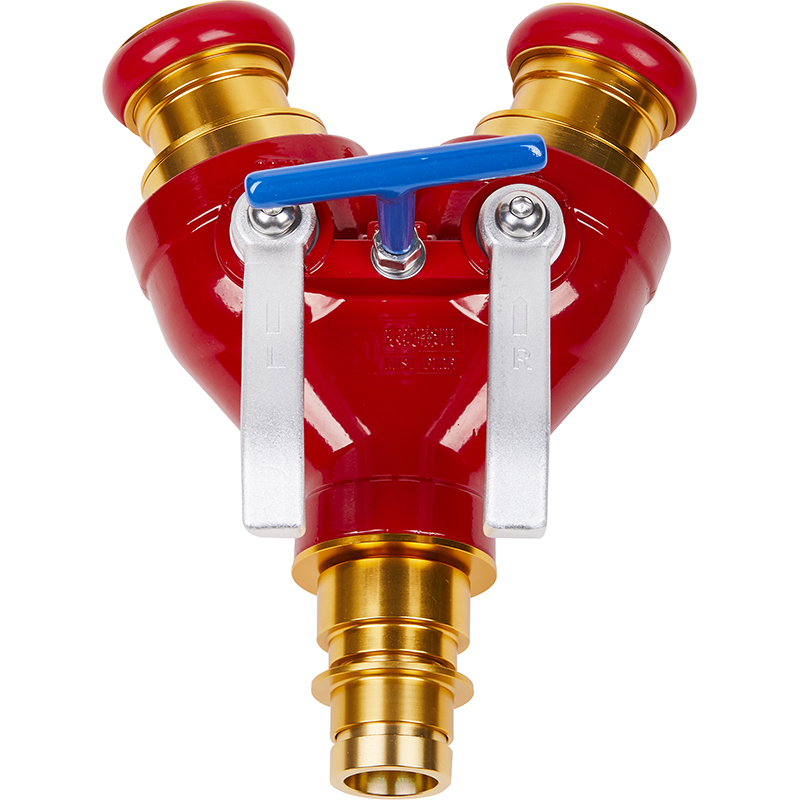
The 3-way manifold offers a highly efficient compromise between scalability and pressure retention. Its internal design typically features a straight-through central port. Two angled lateral ports branch off from this main chamber. This geometry plays a massive role in how fluid travels. The straight port experiences the least amount of internal resistance. Conversely, the lateral ports force water to change direction, increasing local turbulence.
This specific configuration excels in mid-scale distribution scenarios. Standard commercial irrigation systems frequently utilize this layout for symmetrical zoning. It allows operators to run one primary sprinkler bank while managing two smaller drip lines. Furthermore, emergency responders rely heavily on this design. Deployment as a 3-way firefighting water divider remains a standard tactical maneuver. Crews maintain a primary high-volume attack line down the center. They simultaneously deploy two secondary exposure lines for peripheral containment.
A 3-way unit retains operating pressure significantly better than larger manifolds. You face a much lower risk of drastic pressure drops when opening all valves. The internal cavity volume remains relatively small. This compact design keeps the fluid velocity high as it passes through the chamber. For operations operating on municipal hydrant pressure, this efficiency proves invaluable.
Despite its efficiency, this design carries specific physical limitations. Uneven distribution occurs frequently if operators leave all valves fully open. The straight central line naturally creates a path of least resistance. Fluid inherently rushes toward this central opening. Consequently, the lateral lines suffer immediate pressure degradation. Operators must utilize careful manual gating to artificially restrict the center channel. This forces fluid outward into the angled ports.
Expanding to four ports completely changes the hydraulic dynamics of your operation. A 4-way manifold typically utilizes a high-capacity cross design or a sequential block layout. It takes a single high-volume source and fractures it into four distinct operational channels. This introduces massive internal chamber volume. As volume increases inside the manifold, fluid velocity drops proportionally.
These heavy-duty units serve highly specific industrial purposes. Heavy-duty agricultural setups frequently use them alongside high-output commercial pumps. Farms use them to distribute water across massive acreages simultaneously. In emergency contexts, departments deploy them as a 4-way fire hose divider during complex supply-line relay operations. A master pumper truck pushes massive volumes into the divider. Crews then pull multiple lower-pressure distribution lines for widespread scene saturation.
The primary advantage lies in maximum operational versatility. You achieve unparalleled line scalability from a single attachment point. This design completely eliminates the dangerous practice of chaining multiple smaller splitters together. Daisy-chaining manifolds introduces severe physical failure points. It also creates compound friction loss at every connection junction. A solid 4-way block streamlines the entire distribution network.
Scalability comes at a steep hydraulic cost. These units exhibit high susceptibility to severe pressure degradation. Dividing one source four ways stretches the incoming GPM extremely thin. Without independent volume control on each port, outer ports will heavily underperform. Distal lines often dwindle to a mere trickle. You absolutely must pair this manifold with an exceptionally powerful source pump.
Selecting reliable hardware goes far beyond simply counting the output ports. You must evaluate the internal mechanisms governing the flow. The difference between a commercial-grade unit and a consumer-grade toy lies in the components.
You cannot operate complex manifolds safely without precision valving. Integrating a true gated WYE water divider mechanism proves absolutely non-negotiable. Individual gate or full-port ball valves must govern every single port. You need incremental throttling capabilities, not just binary on/off functions. Incremental adjustments allow you to balance pressure dynamically. If one hose runs 100 feet and another runs 50 feet, you must throttle the shorter hose. This creates artificial backpressure, equalizing the flow across both lines.
The physical construction of your manifold dictates its operational lifespan. High-pressure environments quickly destroy inferior metals. The table below outlines the primary materials used in modern flow control hardware.
Material Type | Durability Profile | Ideal Application Environment |
|---|---|---|
Extruded/Cast Brass | Extreme impact resistance; handles severe PSI spikes. | Firefighting, heavy agriculture, industrial wash-down. |
Cast Aluminum | Lightweight but prone to galvanic corrosion over time. | Forestry operations requiring rapid, lightweight deployment. |
High-Density Polymer | Shatters under high PSI; degrades in UV light. | Light residential or temporary low-pressure utility use. |
Internal machining directly impacts turbulence levels. Inferior units feature standard-port valves. These valves contain an internal ball with a hole smaller than the pipe diameter. This creates an immediate choke point. High-quality hardware utilizes smooth-bore, full-port ball valves. The opening matches the hose diameter exactly. This prevents artificial flow restriction and keeps friction loss to an absolute minimum.
Even the highest-quality hardware fails if deployed incorrectly. Operators frequently misunderstand how fluid behaves under pressure. Avoiding common mechanical traps ensures your distribution network remains intact during critical operations.
Many operators assume manifolds automatically equalize pressure. They open all three or four ports and expect identical output. This ignores basic fluid dynamics. Water aggressively seeks the path of least resistance. It favors shorter hoses, larger diameters, and straight-line trajectories. Opening all ports simultaneously will never yield equal pressure naturally. You must execute proper valve throttling. Balancing the system requires manually choking the high-flow ports until the weaker ports catch up.
Connection failures ruin operations instantly. You must diligently verify thread compatibility. Commercial environments utilize different thread pitches. National Hose / National Standard Thread (NH/NST) features coarse threads designed for rapid coupling. National Pipe Thread (NPT) uses tapered threads designed to seal tightly under pressure. Garden Hose Thread (GHT) sits entirely in its own category. Forcing an NPT fitting onto an NST port cross-threads the brass instantly. This destroys the manifold and causes massive high-pressure leaks.
Solid brass 4-way dividers weigh significantly more than basic splitters. When you attach them directly to unsupported spigots, physics works against you. The manifold acts as a heavy lever arm. Once you attach four water-filled hoses, the downward force multiplies exponentially. This leverage easily shears fragile PVC source lines right out of the wall. Always anchor heavy manifolds directly to the floor. Alternatively, use a short whip-hose to connect the spigot to a ground-resting divider. This removes the structural strain from your primary plumbing.
Making the final hardware choice requires objective benchmarking. You must evaluate your pump capacity against your field requirements. Use the structured criteria below to finalize your procurement strategy.
Your source PSI remains strictly moderate and cannot support massive volumetric division.
You need one primary high-flow line flanked by one or two intermittent utility lines.
Overall weight and spatial footprint pose significant constraints for your operational deployment.
You lack the rigid anchoring infrastructure necessary to support larger, heavier manifolds.
You possess high-capacity, mechanically pumped water pressure capable of overcoming extreme friction loss.
You plan to run multiple static, low-flow endpoints simultaneously, such as broad agricultural drip zones.
You operate a rigid, floor-mounted, or securely anchored supply source that withstands lateral pulling forces.
You need to eliminate the failure risks associated with daisy-chaining multiple smaller splitters.
Feature / Requirement | 3-Way Configuration | 4-Way Configuration |
|---|---|---|
Base GPM Requirement | Moderate | Extremely High |
Pressure Stability | Highly stable for varied hose lengths | Prone to severe drops without strict gating |
Anchoring Needs | Minimal (whip-hose recommended) | Mandatory floor or structural mount |
Best For | Targeted attack lines, symmetrical zoning | Mass supply relays, vast area coverage |
Designing a reliable distribution network requires respecting the laws of fluid dynamics. Adding more ports to a system never equates to better performance if the source pressure cannot support them. Overestimating your pump capacity while maximizing your output channels inevitably guarantees terminal failure.
Base your final purchasing decision entirely on mathematical realities. Evaluate your exact pump GPM capabilities first. Determine the absolute necessity of independent gated control for your specific layout. Finally, assess the physical durability required by your environmental conditions. A brass manifold survives industrial abuse, while weaker alloys crumble under the strain.
Before executing any procurement, pull the technical specification sheets for your intended hardware. Review the maximum PSI ratings. Ensure the internal bore dimensions match your hose diameters precisely. Proper preparation guarantees your system delivers the right volume exactly where you need it.
A: No, they do not automatically balance pressure. Internal flow dynamics dictate that water always seeks the path of least resistance. Shorter hoses or straight internal ports receive higher volumes naturally. You must use independent gated valves to manually throttle high-flow channels. This artificial restriction balances the pressure evenly across unequal hose lengths.
A: You will experience two distinct forms of pressure loss. First, you face baseline friction loss caused by internal turbulence inside the manifold chamber itself. Second, you lose pressure through the mathematical division of your total source GPM across all actively open ports. Always consult manufacturer flow-chart specifications.
A: Yes, they perform exceptionally well in emergency scenarios. However, the unit must be explicitly rated for high-PSI, rapid-deployment environments. You must ensure the manifold utilizes extruded brass or specialized heavy-duty alloys. Furthermore, it must feature premium ball or gate valves engineered specifically not to bind or seize under extreme hydraulic loads.


