
Views: 0 Author: Site Editor Publish Time: 2026-11-06 Origin: Site
Picture a chaotic fireground where every single second dictates the outcome. In these high-stress environments, water distribution is the absolute lifeblood of modern firefighting and industrial fire protection. A split-second decision demands equipment that will not fail under pressure. This makes the ability to split a main water line efficiently a paramount engineering concern. A gated wye serves as the essential hydraulic tool for dividing a single water source into two separate attack lines. This vital appliance allows operators to control the flow of each line independently, completely eliminating the hazardous need to shut down the primary water supply.
However, I frequently see procurement teams and safety professionals make critical errors during the selection process. The market is flooded with a dizzying array of sizes, complex thread standards, and varying metallurgical compositions. Choosing the wrong valve triggers catastrophic connection failures, dangerous leaks, or severe flow restrictions right when you need water the most. Specifically, this comprehensive engineering guide will walk you through exactly how to specify the right sizes, outlet connections, and materials for your specific fire hose systems. We will focus on ensuring operational safety and strict regulatory compliance on the ground.
Size Matching is Crucial: Always verify the exact diameter of the main supply line and the intended attack lines before writing a purchase order. The most universally recognized configuration in North American municipal firefighting is a 2.5-inch inlet that reduces to two 1.5-inch outlets.
Thread Compatibility is Non-Negotiable: A fundamental understanding of the differences between National Standard Thread and National Pipe Straight Hose is required. Mismatched connections lead to immediate blowouts under high hydrostatic pressure.
Material Dictates Lifespan and Application: A solid brass valve provides superior durability and exceptional corrosion resistance for heavy industrial applications. In contrast, hard-anodized, lightweight aluminum is the standard for forestry and wildland scenarios where personnel must carry equipment over difficult terrain.
Compliance Matters: Procuring non-compliant hardware introduces severe liability and safety risks. Ensure your chosen equipment rigorously meets relevant National Fire Protection Association standards regarding maximum operating pressure and mechanical reliability.
A gated wye is a fundamental hydraulic manifold utilized extensively in fire protection engineering and tactical firefighting operations. By definition, it is a Y-shaped appliance featuring a single primary inlet and two distinct outlets. Each of these outlets is equipped with an independent quarter-turn ball valve. This structural design allows pump operators to effectively divide a single, high-volume water source into two separate, manageable attack lines.
From an industry perspective, we are witnessing a significant shift in how these appliances are engineered. With the escalating frequency of Wildland-Urban Interface fires and the modernization of industrial petrochemical plants, there is a surging demand for manifolds capable of handling extreme pressure spikes. Historically, standard valves were built for basic municipal flows. Today, the industry trend leans heavily toward precision-engineered, hard-anodized aluminum alloys that can sustain a 1.6 MPa working pressure—roughly 232 PSI—without adding dead weight to a firefighter's loadout. Manufacturers are moving away from generic castings, focusing instead on computer-numerically-controlled machined waterways that drastically reduce friction loss.
The primary functionality of this device centers on hydraulic control and tactical flexibility. It enables multiple attack teams to operate simultaneously from a single water supply point, such as a fire hydrant, an engine pump panel, or a standpipe connection. The critical feature lies in its internal gates. These valves permit operators to independently open, close, or throttle the flow. Consequently, one hose line can be shut down for repositioning without disrupting the continuous flow of water to the secondary attack team. Often referred to in industrial settings as a reliable water divider, this tool is indispensable for maximizing the utility of limited water supplies.
Furthermore, it is important to clearly contrast this appliance with a water thief. The terminology is frequently confused during the procurement process, leading to costly returns. A water thief typically consists of one main inlet and one main outlet of the exact same diameter, allowing the primary volume to continue straight through while featuring smaller, gated side outlets. A wye, on the other hand, completely terminates the primary main line. It splits the entirety of the water volume and pressure into two diverging paths.
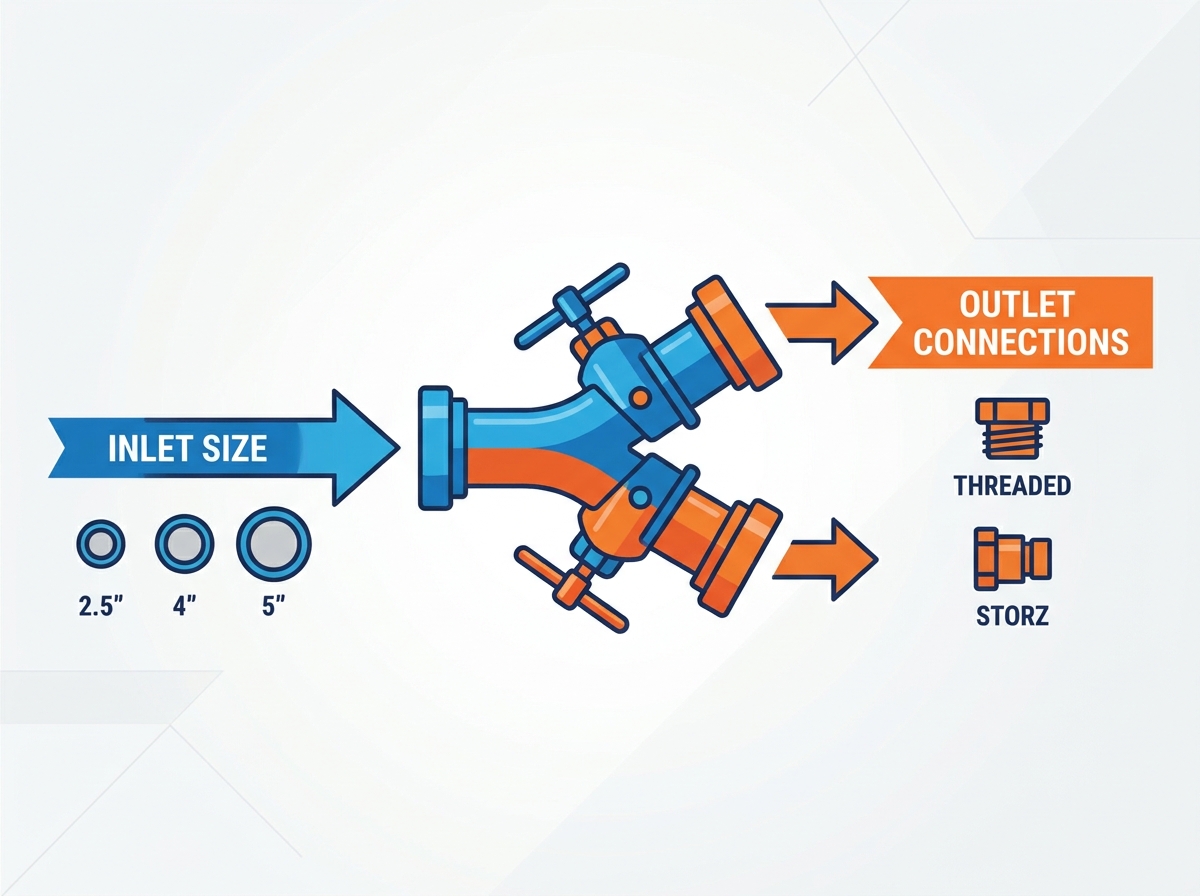
Properly sizing your equipment is a precise engineering process. It requires exact knowledge of your facility's existing hydraulic infrastructure. Operators must identify the exact diameter of the supply line feeding the appliance and the desired diameter of the attack hoses that will deploy from it. Guessing sizes based on visual inspection is a recipe for operational failure.
The inlet represents the female end of the appliance that connects directly to the male thread of your supply hose or fire hydrant. In North American fire protection systems, the most common standard inlet size is 2.5 inches. This is the industry standard for secondary hydrant discharges and municipal supply hoses. Another frequent size is the 1.5-inch inlet, typically utilized in interior structural firefighting standpipe cabinets or smaller brush truck applications. To ensure absolute accuracy before ordering a gated wye valve, operators should utilize digital calipers to measure the outside diameter of the male thread on the supply source. A mismatch here will render the entire unit useless, as it simply will not seat properly to form a watertight seal.
Outlet configurations dictate the size of the attack lines that can be deployed. The operational standard, heavily utilized by municipal fire departments, is a 2.5-inch inlet reducing to two 1.5-inch outlets. This specific setup takes a high-volume supply and steps it down to sizes that are manageable for a single firefighter or a two-person nozzle team. Other empirical variations exist based on specific tactical requirements. For instance, a 1.5-inch inlet splitting into two 1.5-inch outlets is common for forestry applications where lower water volume is acceptable.
The internal diameter and waterway design directly impact the maximum gallons per minute and the associated friction loss. Reducing a 2.5-inch line to two 1.5-inch lines increases water velocity but naturally limits the total volume each line can deliver. High-quality appliances are engineered with smooth, machined interior waterways to minimize turbulence. When selecting a size configuration, hydraulic calculations must be performed to ensure the unit can support the necessary flow rate for the specific nozzles being utilized without introducing excessive pressure drops.
Selecting the correct thread type is arguably the most critical stage of the decision-making process. Even if the nominal diameter sizes match perfectly, acquiring a valve with an incompatible thread type renders the appliance entirely useless. Forcing incompatible threads will strip the metal instantly. This leads to catastrophic failure under pressure, putting personnel at immediate risk.
National Standard Thread, officially designated and frequently referred to as NH, is the predominant thread standard used by municipal fire departments across the United States. It was established to ensure interoperability between neighboring fire districts during mutual aid responses. This standard features a specific thread pitch and outer diameter. If your facility falls under standard municipal fire codes, this is highly likely the required connection type.
In contrast, National Pipe Straight Hose is another common standard that differs significantly. While it shares the same threads per inch as standard pipe thread, it does not taper. These threads are straight, meaning they rely entirely on a rubber or polymer gasket at the base of the female coupling to create a watertight seal. This thread is predominantly found in heavy industrial settings, commercial fire hose systems, and petrochemical plants. It is critical to note that a standard municipal coupling will not safely mate with this industrial fitting.
Storz connections represent a distinct departure from traditional threaded fittings. They are quarter-turn, sexless couplings. There are no distinct male or female ends, meaning any Storz coupling of a specific size can connect to any other Storz coupling of that same size. This design allows for incredibly rapid connections in low-visibility or high-stress environments. While these fittings are most commonly utilized on large diameter hose for main supply lines, some specialized manifolds feature them on the inlet to facilitate rapid deployment.
The metallurgical composition of a fire hose wye dictates its operational lifespan, physical weight, and suitability for specific environments. The operating environment must be the primary factor when deciding between solid brass and aluminum alloys. Making the wrong choice here leads to rapid corrosion or unbearable equipment weight.
Feature | Solid Brass Construction | Hard-Anodized Aluminum Alloy |
|---|---|---|
Weight Profile | Heavy. Often exceeds 10 lbs, making it difficult for long-distance transport. | Lightweight. Usually under 5 lbs, ideal for man-portable operations. |
Corrosion Resistance | Excellent. Impervious to salt water, hard water, and harsh industrial chemicals. | Good. Relies heavily on the integrity of the hard-anodized surface coating. |
Best Application | Petrochemical plants, marine environments, and permanent interior standpipes. | Wildland forestry, high-rise attack packs, and daily municipal engine use. |
Durability & Impact | Extremely high impact resistance. Threads rarely deform when dropped. | High tensile strength, but threads can dent if dropped on hard concrete. |
A solid brass valve is the undisputed engineering standard for extreme durability and longevity. Brass is a dense, robust alloy that exhibits exceptional resistance to mechanical damage, impact, and thread deformation. More importantly, it provides superior resistance to corrosion, rust, and degradation caused by hard water, salt water, and industrial chemicals. Because of these properties, solid brass is the mandatory material choice for heavy-duty offshore marine environments and permanent interior standpipe installations. In these scenarios, the valve may sit unused for decades but must function flawlessly the second it is activated.
To address the significant weight limitations of brass, engineers produce modern alternatives from high-grade, hard-anodized aluminum alloys. The primary advantage here is a drastic weight reduction. These units often weigh less than half of their brass counterparts. This weight reduction is absolutely critical for wildland and forestry firefighters who must carry gear in backpacks over miles of rugged terrain. To mitigate aluminum's natural susceptibility to galvanic corrosion, high-quality units undergo a hard-coat anodizing process. This hardens the exterior and provides a protective barrier against the elements.
Selecting the correct hardware requires aligning technical specifications with the operational realities of your specific industry. A valve built for a hotel hallway will not survive a day in a chemical refinery.
Urban fire departments require heavy-duty, high-flow equipment. The standard is typically a solid brass or heavy-wall anodized aluminum unit with a 2.5-inch inlet and dual 1.5-inch outlets. These units must withstand being dropped on asphalt, dragged over debris, and subjected to aggressive interior attack conditions.
Wildland applications demand ultra-lightweight equipment. Aluminum manifolds, often featuring a 1.5-inch inlet to dual 1.5-inch outlets, are the operational standard. They are specifically designed to be carried in web gear and must operate reliably in environments heavily contaminated with dirt, mud, and ash.
Building codes strictly dictate the requirements for commercial standpipes. These systems require highly reliable, permanent fixtures that integrate seamlessly with building fire hose cabinets. Solid brass is preferred here due to its unparalleled resistance to long-term atmospheric corrosion.
Industrial facilities present harsh, corrosive environments. Refineries and chemical plants require solid brass or specially coated stainless steel valves. These materials can withstand daily exposure to corrosive atmospheric gases, specialized firefighting foams, and harsh chemical agents without degrading over time.
Procuring equipment for life-safety applications requires strict adherence to recognized industry standards. In North America, the National Fire Protection Association sets the benchmark for performance and safety.
The primary standard governing fire hose appliances is NFPA 1965. An appliance claiming compliance with this standard has undergone rigorous laboratory testing. This includes hydrostatic pressure testing, where the unit is subjected to pressures far exceeding standard operating conditions to ensure the casing and internal seals do not rupture under stress.
Buyers must verify the maximum operating pressure rating of the unit. Standard high-quality valves typically feature a working pressure of 1.6 MPa or roughly 232 PSI. It is imperative to ensure that this rating equals or exceeds the maximum discharge pressure capabilities of the facility's fire pump or the municipal fire apparatus supplying the system. A pressure mismatch is a massive safety liability.
For commercial, industrial, and institutional applications, facility insurance policies and local fire codes often require independent third-party verification. Buyers should specifically look for appliances that carry Underwriters Laboratories listings or Factory Mutual approvals. These marks provide empirical proof of safe performance under extreme, real-world conditions.
Even seasoned engineering professionals can make purchasing errors if they aren't paying close attention to the finer details of fluid dynamics and mechanical fittings.
The most dangerous mistake is confusing thread standards. Forcing mismatched threads together will strip the couplings, cause massive leaks, or result in a catastrophic blowout under high pump pressure. This directly endangers personnel working on the attack line.
It is a false economy to purchase a cheap alloy valve for a highly corrosive industrial environment. In these settings, investing in a high-quality solid brass unit is required to prevent rapid degradation, internal seizing, and ultimate failure during an emergency.
In an emergency, equipment must be operable while wearing thick, bulky firefighting gloves. Avoid valves with small, low-profile knobs. Instead, look for robust T-handles or large lever handles that provide adequate mechanical advantage to open a valve against 200 PSI of backpressure.
Remember the standard flow of water. Standard configurations have one female inlet to connect to the pressurized supply hose, and two male outlets to connect to the unpressurized attack hoses. Buying a manifold with the wrong genders will halt your deployment completely, requiring emergency adapters that you likely do not have on hand.
Choosing the right equipment fundamentally saves lives, protects critical infrastructure, and prevents catastrophic property damage. Selecting the ideal hydraulic appliance requires meticulously identifying the correct inlet and outlet sizes, verifying thread compatibility, and choosing the appropriate metallurgical composition based on the operational environment. Mismatched connections cause dangerous delays during emergencies, making exact engineering specifications a non-negotiable aspect of fire safety planning.
A solid brass valve offers lasting durability for heavy industrial use, while hard-anodized aluminum options are vastly superior for rapid deployment and carrying over long distances. I strongly encourage facility managers and procurement officers to review your current fire hose systems today. Consult a specialist to ensure perfect compatibility, or explore a selection of high-quality water dividers at NBDHST to upgrade your facility's emergency readiness. Safety requires careful planning, and having the right precision-engineered tools deployed makes all the difference when the pressure is on.
The most common size utilized by municipal fire departments across North America is a 2.5-inch female inlet splitting into two 1.5-inch male outlets. This specific configuration perfectly balances high-volume water supply with the maneuverability required for smaller, interior attack lines.
No. While they may look incredibly similar to the naked eye, the thread pitches and outer diameters are fundamentally different. Attempting to force them together will cause cross-threading, severe leaking, or a catastrophic blowout under pressure. You must use a specifically machined adapter if the threads do not match perfectly.
A gated wye divides one main pressurized water stream into two separate streams. In contrast, a siamese connection does the exact opposite; it combines two separate water streams into one main supply line. Furthermore, siamese connections typically feature internal clapper valves rather than manually operated gate valves to prevent backflow.
A solid brass valve is highly resistant to chemical corrosion, rust, and mechanical damage. This makes brass the ideal, long-lasting choice for harsh industrial environments, salt-heavy marine applications, and permanent building installations where extreme durability is required and physical weight is not the primary operational concern.
Generally, no. These appliances are engineered strictly for fluid flow in one direction, moving from the single inlet to the dual outlets. Using them backwards to combine flow can severely damage the internal ball valves and polymer seats. Additionally, the standard thread genders naturally prevent backward connections in standard hose lays.
High-quality, professional-grade gated wyes are typically engineered for a standard working pressure of 1.6 MPa, which translates to roughly 232 PSI. However, they are hydrostatically tested at much higher pressures to ensure safety margins. Always verify the specific pressure rating stamped on the appliance before subjecting it to high-pressure pump operations.
Yes, introducing any appliance into a hose lay will create some degree of friction loss, which reduces the overall pressure at the nozzle. Splitting a larger volume of water into two smaller hoses increases velocity but inherently drops the pressure. Engineers design modern wyes with smooth, machined waterways to keep this friction loss as minimal as possible.


