
Views: 0 Author: Site Editor Publish Time: 2026-05-07 Origin: Site
In tactical water delivery, the ability to control and split hose lines in the "hot zone" provides critical operational flexibility. However, misapplying flow-splitting devices can lead to catastrophic pressure loss. A Gated WYE is an essential firefighting valve designed to split a single water source into two or more independently controlled discharge lines. For procurement officers, safety managers, and tactical planners, choosing the right valve is not just about thread compatibility. You must conduct a fact-based evaluation of flow dynamics, material durability, and serious deployment risks. These risks include destructive water hammer or accidental shut-offs in critical moments. This guide breaks down the mechanical realities of Gated Wyes. We will explore exactly when they are tactically sound to use. You will also learn how to evaluate specifications from a reliable water divider manufacturer. By understanding these factors, you can optimize your frontline water delivery safely and effectively.
Directional Function: Gated Wyes split water (one-in, multiple-out), directly contrasting with Siamese valves (multiple-in, one-out).
Flow Realities: Splitting a primary line (e.g., 2.5-inch) into dual operational lines can result in a 21% to 36% flow reduction on the initial line; deployment requires strict hydraulic preplanning.
High-Risk Environments: Experts and NFPA guidelines strongly discourage using Gated Wyes on high-rise standpipe operations due to system flow limits (e.g., 250 gpm) and accidental shut-off risks.
Purchasing Criteria: Quality evaluators should prioritize wide-open waterways to minimize friction loss, and select handle types (quarter-turn vs. slow-close) based on water hammer risk mitigation.
Fireground operations require precise fluid management. We rely on distinct valve types to achieve this goal under pressure. You must understand the mechanical differences between each Fire Water Divider. This categorization provides technical clarity for tactical decisions.
The Gated Wye focuses purely on splitting water. It operates on a straightforward one-in, two-out principle. Some models offer even more discharge ports. Common configurations reduce a larger main line into two smaller attack lines. You might split a 2.5-inch supply line into dual 1.5-inch or 1.75-inch lines. It acts as a portable flow controller. You deploy it forward in the hot zone.
The Siamese Valve does the exact mechanical opposite. It converges water rather than splitting it. You connect two or more inlet water sources. The valve combines them into a single high-volume, high-pressure output. These valves often feature internal clapper mechanisms. Clappers automatically prevent water from flowing backward out of an unused inlet. You use them to boost pressure for large master streams.
The Water Thief offers a manifolding solution. It taps into a Large Diameter Hose (LDH) main feed. You can "steal" multiple smaller lines off this feed. Crucially, the primary high-volume line continues past the valve uninterrupted. This tool supports massive, multi-point water distribution.
Bottom-Line Distinction: Use a Gated Wye for multi-point attack dispersion from a single source. Use a Siamese for supply consolidation.
Valve Type | Primary Function | Flow Direction | Typical Application |
|---|---|---|---|
Gated Wye | Splitting / Dispersing | One-In, Multiple-Out | Forward attack lines, Wildfire defense |
Siamese Valve | Converging / Consolidating | Multiple-In, One-Out | Feeding aerial apparatus, Boosting pressure |
Water Thief | Manifolding / Stealing | One-In, Multiple-Out (with main continuation) | Large scale LDH water distribution |
These tools deliver immense tactical value when applied correctly. You must evaluate optimal use cases based on facts and historical performance. Let us look at where these valves truly succeed in the field.
Rural and Wildfire Operations: They are ideal for long hose lays. Large-property defense relies heavily on them. Departments can stretch a 3-inch or 2.5-inch supply line down a long driveway. Prepared homeowners use similar tactics. You can then split the stream into manageable attack lines. This strategy enables comprehensive structure protection over expansive areas.
Apparatus Pre-Deployment: Many departments use these valves on front-bumper crosslays. You attach the valve directly to the bumper discharge. One connected line supports quick-attack scenarios. You might use it for a fast vehicle fire response. The second line remains fully available. Crews can deploy it for immediate structural hose stretches.
Overhaul and Decontamination: These valves are highly effective during post-fire operations. Overhaul requires lower water pressures. Multiple personnel often need access to localized water streams simultaneously. A split line allows crews to wash down different areas safely. They can cool hot spots efficiently without demanding high pump pressures from the apparatus.
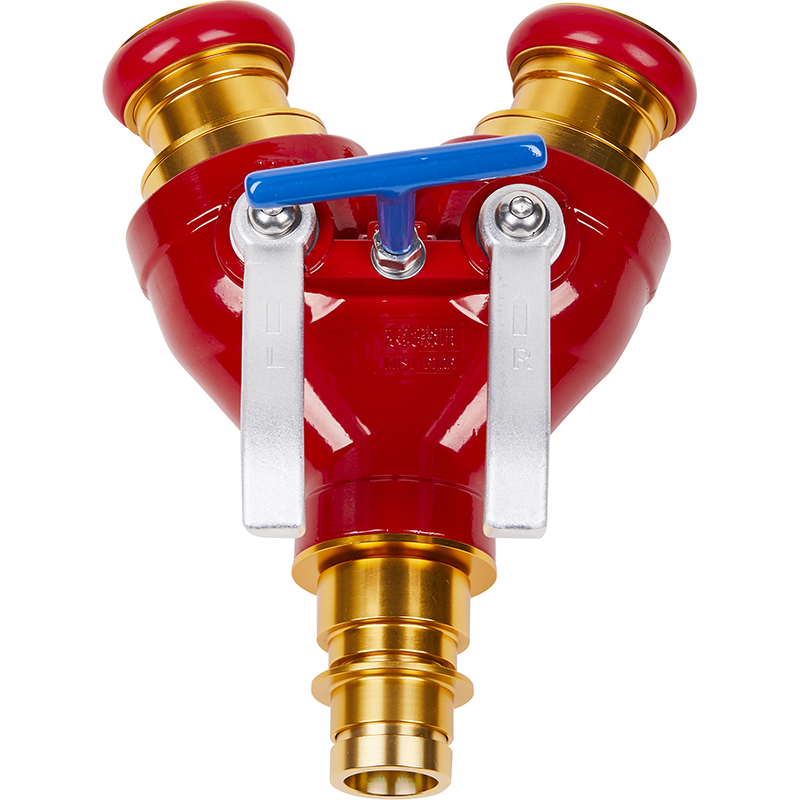
We must highlight critical limitations and dispel dangerous tactical myths. Misusing these tools creates severe hazards for interior attack teams. You must understand the hydraulic realities before deploying them inside a structure.
The High-Rise Standpipe Misstep: Modern fire engineering standards criticize using a Wye off an interior apartment standpipe. NFPA 13E guidelines dictate strict performance rules. A standard 2.5-inch standpipe outlet is only designed for 250 gpm. This volume is completely insufficient for dual large-caliber lines. Opening two nozzles will starve both attack teams of adequate water.
The "Kicked Shut" Hazard: Interior attack environments are tight and offer low visibility. Standard quarter-turn handles create a massive vulnerability here. Passing personnel can easily kick or bump them closed. This action instantly cuts water to the nozzle team fighting the fire. It is a lethal threat in a high-heat environment.
Hydraulic Blowback and Pressure Spikes: Imagine two lines flowing simultaneously. Suddenly, one line is abruptly shut down at the valve. The remaining line immediately experiences a violent pressure spike. This surge creates severe nozzle reaction forces. These forces can easily physically injure firefighters holding the active line.
Risk Mitigation Strategies: If you must use this valve, personnel must employ strict discipline. They must use clear radio communication before opening or closing valves. You must alert the other nozzle team before changing the flow. Alternative tactics exist for high-rises. Consider using floor-staggered single gate valves instead of splitting a single floor outlet.
Procurement decisions should bridge physical features to direct operational outcomes. You need to know which specifications matter most. Quality evaluators look beyond the price tag.
Waterway Engineering: Always look for "wide-open" internal waterway designs. Traditional, poorly cast valves introduce severe friction loss. They restrict the water flow unnecessarily inside the chamber. Modern engineered valves minimize internal turbulence. This smooth internal design helps preserve critical pump pressure over long hose lays.
Handle Configurations (Speed vs. Safety): Handle choice dictates operational safety on the fireground. You have two primary options to evaluate.
Quarter-Turn Folding Handles: These are best for rapid deployment. They allow very fast water flow initiation. They also offer compact storage on the apparatus. However, they carry the highest risk of accidental shut-off.
Slow-Close Handles: These are essential for preventing water hammer. You slowly restrict the flow over several turns. This action protects municipal infrastructure. It shields fire pumps and the hose bed from destructive hydraulic shockwaves.
Material Durability: Material choices define the lifespan of the tool.
Hard Anodized Aluminum: This metal is lightweight and highly corrosion-resistant. It remains the ideal choice for standard structural firefighting apparatus. It reduces fatigue during carrying.
Brass: This material is much heavier but exceptionally durable. Industry professionals heavily favor it for permanent maritime installations. You will also see it in high-end residential wildfire defense systems.
Your vendor selection directly impacts fireground safety. You need a rigorous shortlisting logic to find the best supplier. Partnering with a reliable water divider manufacturer guarantees you receive certified, field-ready equipment.
Thread Compatibility and Customization: Fire departments operate on highly specific regional thread standards. Common examples include NST, NH, and NPSH. A competent vendor must offer a Customizable Gated WYE. This unit must perfectly match the agency's existing hose inventory. Perfect matching prevents disastrous cross-threading during high-stress emergencies. You cannot afford a mismatched thread when the fire is growing.
Pressure Ratings: You must demand clear, certified pressure testing limits. A standard structural valve should confidently handle high pressures. Operating pressures up to 300 psi are typical. Check the certification documents carefully. A vendor should eagerly provide hydrostatic test results.
Serviceability: Quality valves feature field-serviceable parts. You should be able to replace polymer valve seats easily. Handles should be quickly swappable in the firehouse maintenance bay. Avoid single-use, disposable assets. Serviceable tools provide a much longer operational lifespan.
The Gated Wye is an indispensable tool for fireground fluid management. It excels in rural relays and proactive wildfire defense. It perfectly handles localized flow division needs. However, it must be kept strictly away from low-volume standpipe systems. Tight interior attacks also present lethal accidental shutoff threats. You must deploy it where the facts support its use.
Next Steps:
Procurement teams should audit their current standard operating procedures (SOPs) regarding multi-line deployments.
Identify high-risk deployment scenarios and update tactical training protocols immediately.
Partner with a reputable manufacturer to source high-quality valves.
Prioritize optimal waterway casting and appropriate handle safety mechanisms.
Demand precise thread customization to match department needs seamlessly.
A: Flow dynamics dictate that the primary supply line has a maximum gallon-per-minute (gpm) limit. Splitting the stream forces the available water volume to divide, routinely dropping initial line flow by 20% or more depending on the hose diameter.
A: A Gated Wye divides one water source into two or more controllable outputs. A Siamese valve converges two or more water sources into a single, high-volume output (often featuring clapper valves to prevent backflow).
A: Yes, in many jurisdictions, high-quality brass Gated Wyes are used by homeowners to legally adapt standard 2.5-inch hydrant flows down to manageable 1.5-inch dual property defense lines, provided they have the correct permits and thread compatibility.
A: Closing a high-pressure line too quickly causes a "water hammer"—a hydraulic shockwave that travels backward through the hose, which can rupture lines, damage fire apparatus pumps, and burst municipal water mains. Slow-close handles physically prevent rapid shut-offs.


