
Views: 0 Author: Site Editor Publish Time: 2026-06-04 Origin: Site
Selecting the right equipment dictates mission success on the fireground. The hardware you choose directly impacts water delivery, nozzle reaction, firefighter fatigue, and ultimate suppression efficiency. Departmental procurement teams often struggle to balance legacy tools against new flow technologies. This friction leads to mismatched pump discharge pressures (PDP) and highly inconsistent hose operations under stress. Poorly matched equipment can easily endanger crews. It compromises the entire hydraulic system if you do not calculate the metrics correctly.
This guide breaks down essential Fire Nozzle architectures and the operational trade-offs you must consider. We will explore NFPA compliance criteria to support data-driven procurement and sound tactical decisions. You will learn how to match specific spray patterns to hazardous environments safely. We also outline how you can navigate implementation risks to protect your personnel.
Flow vs. Pressure: Nozzle selection must align with department-standard operating pressures (typically 50, 75, or 100 psi) to manage nozzle reaction effectively.
Category Distinctions: Smooth bore nozzles offer maximum reach and penetration with minimal moving parts, while combination nozzles provide versatile spray patterns for thermal cooling and personnel protection.
Compliance is Baseline: Evaluation must begin with NFPA 1964 standards and verify materials (e.g., hardcoat anodized aluminum vs. brass) against the department's specific operational environment.
Training Dictates Tech: Adopting automatic or selectable gallonage nozzles requires rigorous pump operator training to prevent under-pressurization and catastrophic flow loss.
Fire departments rely on several foundational designs to manage water delivery. Understanding these architectures helps you match the tool to the specific tactical objective.
This design represents the oldest and most reliable form of water delivery. They utilize a simple, un-obstructed waterway.
Mechanism: They deliver a solid stream via stacked or fixed tips. You can change tip sizes to adjust the flow rate.
Outcomes: They provide high volume and deep penetration. They cause minimal thermal layer disruption. They also pass debris reliably from municipal water sources.
Best for: You should use them for standpipe operations and high-wind environments. They fit departments prioritizing low operating pressures, typically around 50 psi. Lower pressures significantly reduce firefighter fatigue.
Best Practice: Always remove unneeded stacked tips before advancing the line. This ensures you do not accidentally restrict your intended flow rate during an interior attack.
These devices offer extreme versatility. They allow the nozzleman to alter the water stream based on immediate fireground conditions.
Mechanism: They create an adjustable stream ranging from straight to wide fog. They achieve this via a rotating bumper and an internal baffle system.
Fixed Gallonage: This variant delivers a specific flow rate at a specific pressure. It remains highly predictable. Pump operators find it easy to calculate friction loss.
Selectable Gallonage: This allows the nozzleman to adjust flow rates manually. You might select 95, 125, 150, or 200 GPM.
Risk note: Prone to operator error under stress if not matched with engine RPM.
Automatic Nozzles: This type maintains constant pressure and stream reach. It automatically adjusts the internal baffle based on the available water flow.
Risk note: Can mask inadequate water volume, creating a dangerous illusion of effective suppression.
Common Mistake: Pumping an automatic nozzle at low pressures. It looks like a good stream, but it lacks the actual GPM needed to absorb heat.
Certain incidents require highly specialized water delivery methods. Standard handlines cannot always reach the seat of the fire.
Piercing / Cellar Nozzles: Manufacturers design these for penetrating structures. You can drive them through walls, floors, or aircraft fuselages. They deliver water directly into confined, completely inaccessible spaces.
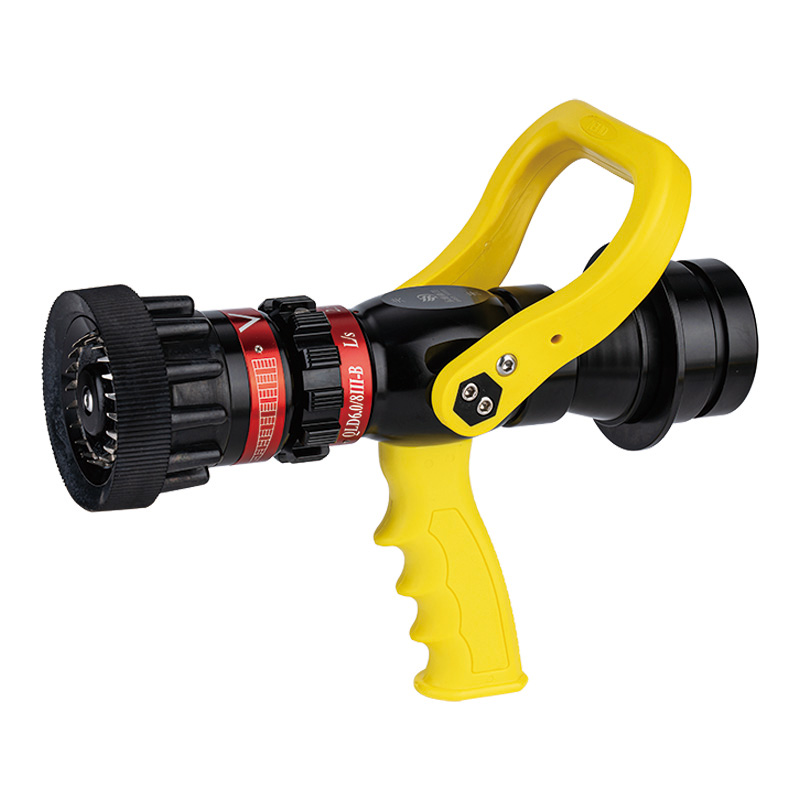
The shape of the water leaving the hose determines how it interacts with heat. You must select the correct pattern to avoid pushing fire or steam-burning your crew.
A smooth bore tip creates a solid stream. It forms a compact water column travelling through the air. This shape maximizes kinetic energy. It excels at breaking apart structural materials. You need this energy to reach the seat of deep-seated fires.
A combination nozzle creates a straight stream. It feels highly focused but it differs from a solid stream. It is composed of tightly packed droplets rather than a solid column. It offers comparable reach to a solid stream. However, it causes slightly more air entrainment. This can disrupt the thermal balance slightly more than a solid tip.
Fog patterns fundamentally change the suppression dynamic. You adjust the bumper to spread the water droplets widely.
Function: It maximizes water surface area. This allows for rapid heat absorption and massive steam conversion.
Applications: Crews use it for hydraulic ventilation. It provides excellent crew protection against radiant heat. It works perfectly for cooling industrial environments.
Industrial Context: Fog patterns are critical for suppressing Class A/B fires in manufacturing facilities. These locations feature localized hazards. Examples include plants operating heavy machinery, chemical processors, or high-friction plastic bag making equipment. In these areas, rapid ambient cooling is required without scattering highly combustible dust into the air.
Pattern Type | Air Entrainment | Thermal Disruption | Primary Tactical Use |
|---|---|---|---|
Solid Stream | Minimal | Low | Deep penetration, exterior attack |
Straight Stream | Moderate | Moderate | Interior attack, reach |
Narrow Fog | High | High | Rapid heat absorption |
Wide Fog | Very High | Very High | Crew protection, ventilation |
Procurement teams must look past marketing claims. You must evaluate the hard specifications to ensure operational safety and long-term durability.
Water volume extinguishes fire, not pressure. You must map the required Gallons Per Minute to your target fire loads. Residential fires require different flows than commercial structures.
Evaluate the crucial trade-off between pressure and nozzle reaction force. We measure this force in pounds of pushback. Lower pressure systems running at 50 to 75 psi drastically reduce physical strain. However, this setup requires larger diameter hoses to maintain the necessary GPM. You must balance hose weight against pushback force.
The construction material dictates the lifespan and maneuverability of the equipment. We typically see three main categories.
Hardcoat Anodized Aluminum: This serves as the industry standard. It provides the optimal strength-to-weight ratio. It resists corrosion well and reduces firefighter fatigue during extended operations.
Brass: This metal is highly durable. It remains heavily corrosion-resistant for marine applications. It suits highly corrosive industrial environments perfectly. However, it carries a significant weight penalty.
Polycarbonate / Composites: These materials are exceptionally lightweight. Departments often use them in forestry or wildland applications. Prolonged carry weight is the primary constraint in those scenarios.
You cannot compromise on safety certifications. Life safety equipment must meet strict external validations.
Always verify compliance with NFPA 1964. This acts as the Standard for Spray Nozzles. It dictates minimum performance metrics and testing protocols. Look closely for UL or FM approvals. These are especially critical for fixed industrial installations. Commercial facility procurement mandates these specific approvals for insurance compliance.
The debate between these two styles dominates the fire service. Shortlisting the ideal Fire Nozzle requires objective analysis. You must evaluate your specific operational realities rather than relying on tradition.
Reliability under stress defines a good tool. Smooth bore models fail predictably. If the pump pressure drops, the stream visibly sags. This instantly alerts the interior crew to a water supply issue. They can back out safely.
Automatic combination models fail silently. They maintain their tight stream shape even at critically low flow rates. They look effective visually. However, they deliver unsafe GPM levels. This tricks the crew into staying inside a hazardous environment.
Different shapes move different amounts of air. Combination models move significantly more air. This can negatively alter fire behavior. If used incorrectly during interior structural attacks, they push fire into unburned areas. Smooth bores minimize this risk. They slide through the thermal layers efficiently.
Equipment upkeep drains departmental resources. You must consider the lifecycle maintenance requirements.
Smooth bore: They require virtually zero maintenance. They are highly resilient to debris. They easily pass scale and rocks from older municipal water systems.
Combination: They demand rigorous upkeep. You must perform regular lubrication. You need strict baffle inspections. Crews must utilize flush settings constantly to clear trapped debris.
Base your final decision on hard data, not brand marketing. Look at your department's existing hose inventory. Evaluate typical staffing levels. Fewer personnel dictate a need for lower, more manageable nozzle reaction forces. Finally, assess your pump operator training protocols. High-tech equipment requires high-tech training.
Buying new equipment solves only half the problem. Deploying it improperly creates massive tactical vulnerabilities. You must manage the transition deliberately.
Purchasing automatic models requires the immediate retraining of your pump operators. Relying on legacy friction loss calculations will result in improper pressurization. Automatic internal baffles mask poor pump mechanics. Operators must learn to read their flow meters, not just their pressure gauges.
Common Mistake: Giving new selectable gallonage tools to crews without updating the pump charts on the apparatus. This guarantees catastrophic flow loss during the first major incident.
Mixing different types on the same apparatus invites disaster. Without clear guidelines, crews grab the wrong tool. You must implement color-coded or tactile operational guidelines. Inconsistent setups lead to severe tactical confusion on the fireground. When visibility drops to zero, muscle memory takes over. Standardize your pre-connects.
You cannot assume a tool works flawlessly forever. Mechanical springs weaken. Internal baffles corrode. You must mandate annual flow testing.
Connect the equipment to an inline flow meter.
Measure the stream output utilizing a handheld pitot gauge.
Compare the actual output against the manufacturer's rated GPM.
Remove any unit from service if it fails to meet its pressure specifications.
There is no single universally "best" option for every department. The right choice represents a localized equation. You must carefully balance your required GPM, manageable reaction forces, and internal training maturity. A high-flow automatic device fails instantly if your pump operators do not understand its mechanics.
Procurement teams should request live-fire flow demonstrations from manufacturers. Test the hardware using your department's actual apparatus. Flow water through your existing hose loads before committing to any purchase. Data gathered on your own training ground is infinitely more valuable than a brochure. By standardizing your selection and rigorously testing your inventory, you ensure your crews always have the hydraulic power they need to suppress hazards safely.
A: The standard operating pressure is typically 50 psi for handheld attack lines. For master streams and ground monitors, the standard pressure increases to 80 psi. Operating at these lower pressures significantly reduces nozzle reaction, making the hose easier for a limited crew to handle safely.
A: Yes, they can achieve the exact same flow capacities. However, combination models usually require higher pump discharge pressures (often 75 or 100 psi) to overcome internal friction loss. The engine must generate adequate pump pressure to push that specific GPM through the complex baffle system.
A: NFPA 1962 guidelines mandate that departments conduct comprehensive flow testing at least annually. Additionally, crews must perform a thorough visual and mechanical inspection after every single use to ensure debris has not compromised the internal waterway or moving parts.
A: Nozzle reaction is the physical pushback force generated by water exiting the tip. It matters because excessive pushback rapidly exhausts firefighters. If procurement selects high-pressure equipment without considering staffing levels, a short-staffed hose line crew will struggle to sustain deployment times effectively.


