
Views: 0 Author: Site Editor Publish Time: 2025-09-18 Origin: Site
Fire is never a one-size-fits-all threat—so your firefighting equipment shouldn't be either. Different fire types, environments, and response objectives require different suppression strategies. That’s why it’s crucial to choose the right fire nozzle for each situation. The effectiveness of your response, the safety of your crew, and the conservation of resources all depend on whether your nozzle is properly matched to the fire’s behavior and intensity.
The wrong nozzle can mean wasted water, delayed extinguishment, or even increased risk to operators and victims. In contrast, the right nozzle delivers precise water or foam patterns with optimal pressure and reach. At TOKAI MORITA, we engineer our fire nozzles to support varied fire suppression strategies—whether you’re battling warehouse fires, chemical spills, or rescuing people in confined spaces. By understanding how each nozzle type performs in specific situations, decision-makers can improve outcomes and safety.
Before selecting a nozzle, you need to evaluate the fire scenario. What are you trying to extinguish? Where is the fire located? How much risk does it pose to people, property, or the environment? These answers shape your nozzle choice.
Class A fires involve common combustibles like wood, paper, and cloth. These fires are typically fought with water, and the goal is to saturate the fuel to cool and extinguish it. For these situations, fog nozzles with wide spray patterns or adjustable mist modes are ideal. They allow for greater surface cooling while minimizing water runoff and property damage.
TOKAI MORITA’s selectable fog nozzles let teams adjust spray width in real-time, helping them adapt as fire intensity changes. Wide fog also provides a protective barrier against heat, giving operators a safer approach path.
Fires involving oil, gasoline, and other flammable liquids require a very different approach. Water alone can spread the fuel or prove ineffective. Foam nozzles—especially air-aspirating types—are the best option here. These nozzles mix water with foam concentrate and air to create a thick, insulating blanket that smothers flames and seals vapors.
TOKAI MORITA’s air aspirating foam nozzles are designed to deliver consistent expansion ratios, even under fluctuating pressure conditions. They’re widely used in fuel storage depots, factories, airports, and hazardous material response units.
In tight spaces or multi-story buildings, ease of movement and precise control are crucial. Bulky nozzles can slow response times or tire out firefighters. In these scenarios, ergonomic and lightweight adjustable nozzles are ideal. Selectable gallonage fog nozzles with pistol grips allow crews to adapt quickly to changing layouts and conditions.
Our adjustable fog nozzles at TOKAI MORITA are compact yet powerful, offering both straight stream and narrow fog options. They help teams maintain pressure and accuracy in vertical firefighting or dense interior operations.
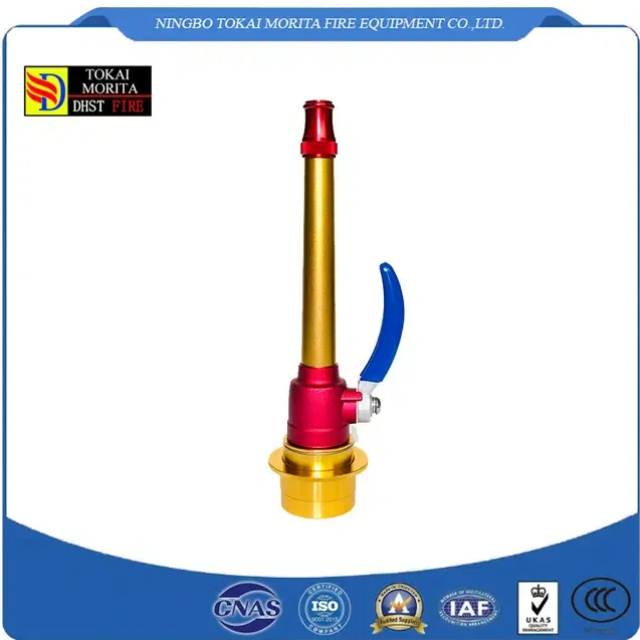
Once you’ve assessed the fire type and environment, the next step is to understand the technical criteria that affect performance and usability. Here are the essential considerations when you choose a fire nozzle:
Flow rate determines how much water the nozzle delivers per minute, typically measured in gallons per minute (GPM). A higher GPM is necessary for large fires or open areas, while lower GPM settings may be more efficient indoors. Similarly, pressure rating—measured in PSI—affects stream reach and spray pattern stability. Some fires require long-range solid streams, while others benefit from lower pressure mist applications.
TOKAI MORITA nozzles cover a wide range of flow options, from 30 GPM for precision work to 125+ GPM for aggressive suppression. They’re also built to handle variable inlet pressures without loss of performance.
Nozzles must be compatible with existing fire hose threads and hydrant systems. Whether your infrastructure uses NST, ANSI, or international standards, the nozzle must form a tight, leak-free seal. Poor fittings can lead to water waste, dangerous pressure surges, or system failure.
All TOKAI MORITA nozzles come with standardized threads and optional adaptors to ensure full compatibility with global hose and hydrant setups. This simplifies procurement and field integration for departments with mixed equipment sources.
A nozzle’s design affects more than just spray pattern—it influences how easily crews can use it. Heavy or poorly balanced nozzles can fatigue users quickly, especially during extended operations. Inexperienced teams may also struggle with complex controls or non-intuitive adjustment systems.
That’s why we focus on ergonomic designs, intuitive flow selectors, and lightweight materials like forged aluminum alloy. TOKAI MORITA nozzles are field-tested for ease of use, even by minimally trained operators, while still offering precise performance for advanced teams.
Different users face different fire risks and operational demands. The right nozzle for a city fire department may not work in a chemical plant or oil refinery. Here are some real-world contexts and nozzle pairing strategies:
Urban fire departments need nozzles that are versatile and easy to deploy. Structure fires, car accidents, and kitchen fires all require different suppression techniques. Selectable fog nozzles with multiple spray modes and flow rates give municipal crews the flexibility to handle varied incidents. These nozzles also integrate well with existing municipal hose sizes and hydrant valves.
Factories, refineries, and storage facilities require targeted suppression of hazardous materials. Foam nozzles are often standard here. High-capacity nozzles that can be mounted on monitors or turrets may also be necessary for large-scale coverage. Durability, pressure resistance, and corrosion-proof materials are essential for long-term industrial use.
TOKAI MORITA’s industrial-grade foam and smooth bore nozzles are manufactured with heat-treated brass and precision-machined internals to ensure reliable function in aggressive environments.
Emergency units and wildland teams need portable, lightweight nozzles that function reliably under extreme terrain conditions. In these cases, compact nozzles with mist or straight-stream options are vital for both suppression and crew protection. Water curtain nozzles, for example, can be used to create thermal shields during rescue entry.
TOKAI MORITA offers field-ready solutions for these scenarios with quick-connect nozzles that work seamlessly with portable pumps and lightweight hose systems.
Some departments prefer multi-function nozzles that can adapt to several fire types. Others prioritize specialized nozzles for specific risks (e.g., chimney fires or deep-seated industrial fires). The decision depends on your response frequency, team training, and typical hazards. In either case, understanding your daily operational profile helps you choose the right fire nozzle confidently.
To successfully suppress a fire, your team needs more than water—it needs the right nozzle for the job. Whether you're battling a Class A blaze, a fuel spill, or a high-rise rescue scenario, your ability to choose a fire nozzle that aligns with fire behavior, system pressure, and crew capacity will determine your effectiveness.
At TOKAI MORITA, we combine precision engineering with real-world experience to deliver nozzles that match any firefighting challenge. From adjustable fog models to industrial foam applicators, our fire nozzle range is designed to meet your technical requirements and operational goals.
Contact us today to learn more about selecting the perfect fire nozzle for your environment and let our experts help you build a safer, smarter suppression strategy.


